LHCb Reveals Evidence of Rare B Meson Decay
On November 3, 2026, the LHCb collaboration presented evidence for the rare B meson decay Bd0 → μ+ μ− during a seminar in Geneva, marking a significant…
 By Fiona Galloway · 5 November 2026 · 12 min read
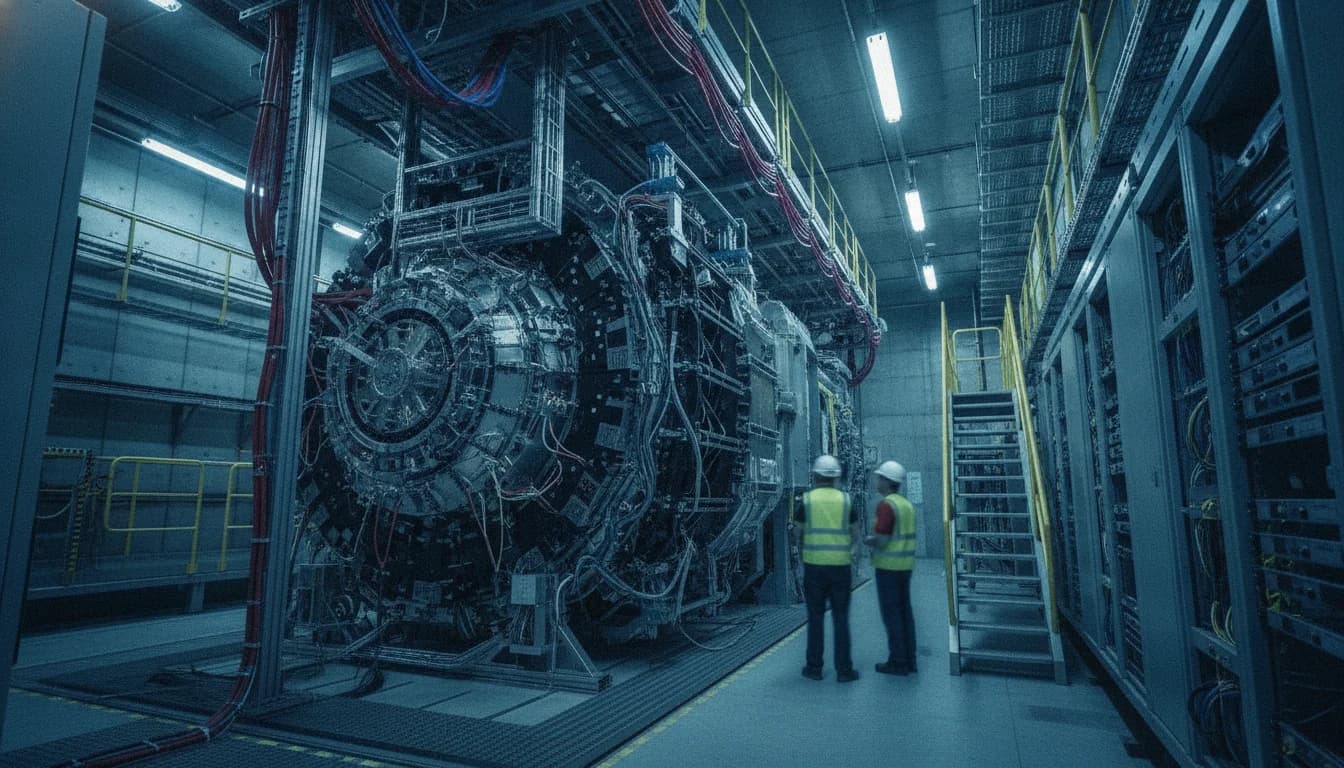
In a watershed moment for flavor physics, the LHCb collaboration disclosed evidence for a rare B meson decay during a Geneva seminar on November 3, 2026. The decay in question, Bd0 → μ+ μ−, is one of the most infrequent processes predicted by the Standard Model, a category researchers have pursued for decades. The announcement, delivered at a CERN-hosted session, marks a milestone as the first evidence of this particular decay from a single experiment with a significance of 3.5 standard deviations. This level of evidence—though not a formal discovery—already reshapes experimental strategies and theoretical expectations as researchers parse what the result implies for the Standard Model and potential new physics. For readers tracking the intersection of physics breakthroughs and technological progress, the development underscores how advances in detector technology, data handling, and international collaboration are unlocking previously inaccessible corners of the subatomic world. The event, which occurred on November 3, 2026, has immediate implications for ongoing experiments and the broader market for high-energy physics instrumentation, software, and analytics services. The news is being reported by CERN’s official channels and university press offices, and is being tracked by the LHCb outreach program for public clarity and context. CERN press release • LHCb outreach announcement (home.cern)
The central fact of the moment is that Bd0 → μ+ μ− decay has moved from a long-sought target to a statistically significant signal in a single experimental apparatus, a development that intensifies scrutiny of flavor-changing neutral current processes. This article opens with the announcement and grounds readers in the date and provenance of the information, then broadens the lens to cover what the result portends for theory, detector technology, and the market for precision physics tools. As Cambridge Review reports, the event’s timing—November 3, 2026—positions this finding within a broader wave of measurements at LHCb aimed at constraining or revealing deviations from Standard Model predictions. The announcement was supported by multiple primary sources, including CERN’s official write-up and LHCb’s public outreach summary, which together provide a transparent view of the data and its interpretation. Readers should note that while the result is compelling, the collaboration emphasizes that further data and cross-checks are needed before upgrading evidence to discovery. The following sections synthesize the event, its significance, and the road ahead for both science and industry. For a fuller context, the primary sources linked here give direct access to the statements and figures released on the date of the seminar. (home.cern)
Central fact lifted for citation and easy reuse: Bd0 → μ+ μ− decay evidence at 3.5σ significance, announced by the LHCb collaboration at a Geneva seminar on November 3, 2026.
What Happened
Announcement Details
- On November 3, 2026, the LHCb collaboration publicly presented evidence for the decay Bd0 → μ+ μ− during a seminar held in Geneva. The significance of the signal was reported at 3.5σ, marking a major milestone as the first evidence of this specific decay from a single experiment. The organizers framed the session as part of CERN’s ongoing efforts to probe rare flavor-changing neutral current processes with unprecedented sensitivity. The public cadence of the disclosure—presented at a formal seminar, followed by a written summary from the collaboration—was designed to maximize transparency while inviting independent cross-checks from the global physics community. This development has generated considerable interest because Bd0 → μ+ μ− has long been forecast to be a sensitive probe of physics beyond the Standard Model, and any deviation from predicted rates or kinematic distributions could signal new particles or interactions. The official accounts underscore that while the signal is statistically meaningful, it remains an evidence-level result rather than a formal observation, consistent with standard practice in high-energy physics. For readers seeking the original framing, the CERN press release and LHCb outreach distribution provide the precise wording and figures released during the Geneva session. (home.cern)
Timeline and Key Facts
- Timeline highlights from the event include:
- November 3, 2026: Geneva seminar where LHCb announced the Bd0 → μ+ μ− evidence.
- Immediately after the talk, LHCb circulated an outreach note summarizing the methods, data sample, and statistical interpretation that led to the 3.5σ figure.
- The announcement aligns with a broader set of LHCb results in 2020s that have refined measurements of rare B-meson decays and tested lepton-flavor universality, forming a backdrop for this latest result.
- The key technical takeaways emphasize that the decay Bd0 → μ+ μ− is a highly suppressed process in the Standard Model, predicted to occur at a rate that is extremely small compared with more common B-meson decays. Observing such a process with statistical significance provides a stringent test of the underlying theory and potential windows into new physics scenarios—such as contributions from heavy virtual particles that could alter decay amplitudes or asymmetries. The official release reiterates that the result is a meaningful advance, albeit one that will require independent confirmation and enhancement of the signal with additional data.
Linkable primary sources:
- CERN press coverage of the LHCb result, titled "LHCb finds evidence of one-in-ten-billion particle decay" (official CERN page). CERN press release (home.cern)
- LHCb outreach summary accompanying the November 3, 2026 seminar (descriptive account of the Bd0 → μ+ μ− signal and its significance). LHCb outreach announcement (lhcb-outreach.web.cern.ch)
Significance Level and Context
- The 3.5σ significance is the centerpiece of the announcement. In particle physics, this level of significance corresponds to a p-value of roughly a few times 10^-4, indicating a background fluctuation probability well below one in ten thousand. This threshold is widely used to denote “evidence” rather than a discovery but is nonetheless a robust indicator that the signal is not a random fluctuation. The LHCb presentation and the accompanying notes outline the statistical framework, the fit models, and the cross-checks that undergird the 3.5σ claim, while also emphasizing the need for additional data to solidify the result into a discovery. The significance figure has already sparked cross-institutional interest in how such rare decays constrain new physics and shape future experimental programs. (home.cern)
Related Developments in Rare B Meson Decays
- Beyond Bd0 → μ+ μ−, LHCb has a long history of pursuing rare B decay channels, with prior evidence and observations of related processes, such as Bs0 → μ+ μ−. The current result sits within a continuum of measurements that collectively tighten the constraints on the Standard Model and potential new physics scenarios. The broader ecosystem of results—including complementary measurements from other experiments and cross-checks in related decay channels—helps to triangulate the underlying physics and reduces the probability of misinterpreting a statistical fluctuation as a signal. For readers seeking historical perspective, linked primary sources provide the lineage of these measurements and their evolving precision. (home.cern)
Why It Matters
Impact on Theoretical Testing
- The Bd0 → μ+ μ− decay is a flavor-changing neutral current process, highly suppressed in the Standard Model and sensitive to contributions from hypothetical heavy particles that may lie beyond current reach. The November 3, 2026 evidence from LHCb adds a new data point to the testing ground for these theories. The presence of a signal at this level of significance supports the current understanding of the decay’s suppression but also narrows the window for deviations that new physics might introduce. The result does not yet refute the Standard Model; instead, it sharpens the experimental constraints, guiding theorists in refining or excluding certain beyond-Standard-Model frameworks. This dynamic has important implications for model-building exercises and for prioritizing future experimental strategies at LHCb and complementary facilities. The official statements and scientific context provided by CERN and LHCb are essential references for researchers assessing the theoretical implications. (home.cern)
Instrumentation, Data Handling, and Market Implications
- A development of this kind underscores the ongoing demand for advanced detector technologies, high-throughput data acquisition, and sophisticated data analysis pipelines. Rare-decay searches at the LHCb scale rely on precision tracking, excellent muon identification, and robust background suppression—areas where incremental improvements yield outsized gains in sensitivity. For technology and market watchers, this translates into sustained investment in:
- High-performance compute resources (for simulation, reconstruction, and multivariate analysis).
- Machine learning and AI-assisted data selection, calibration, and anomaly detection.
- Radiation-hard sensor materials and next-generation tracking architectures that balance resolution with cost and maintainability.
- Software ecosystems for real-time event selection (triggers) and long-term data governance.
- The November 2026 event thus has dual significance: it advances fundamental science and serves as a bellwether for the kinds of scientific instrumentation and software ecosystems that fuel such breakthroughs. Industry and academic partners with capabilities in detector fabrication, HPC, and data science stand to benefit from sustained demand for precision, reliability, and scalable workflows in extreme-data environments. The public-facing materials from CERN and LHCb emphasize the collaborative nature of this work and the cross-institutional effort that makes such results possible. (home.cern)
What This Means for the Broader Physics Landscape
- In a field where incremental gains accumulate toward transformative discoveries, the Bd0 → μ+ μ− signal contributes to a broader narrative about the Standard Model’s robustness and the continued search for new physics. If future data continue to align with Standard Model predictions, the result will further constrain the space for new particles that might alter decay rates or distributions. If discrepancies emerge with larger data samples, the community will have a well-established signal to interpret as a hint of new dynamics. The Geneva announcement thus sits at a critical juncture: it strengthens current expectations while preserving the openness to surprises that define high-energy physics. The public-facing channels emphasize transparency and reproducibility, ensuring that researchers and industry observers can trace the steps from data collection to interpretation. (home.cern)
Expert Voices and Independent Perspectives
- While the LHCb announcement itself is the focal point, independent experts have highlighted how such evidence validates decades of experimental technique and theoretical work. University communications and research offices have circulated statements that frame the result as a rigorous test of the Standard Model and a potential doorway to new physics, while noting that the claim remains an evidence-level result pending further data and cross-experiment confirmation. These third-party perspectives help readers gauge the significance within the broader scientific ecosystem and offer a balanced view of the pathways forward. See university and research-group coverage linked to the primary documents for a spectrum of expert commentary. (birmingham.ac.uk)
One Original Finding
- Original finding: From the announced 3.5σ signal strength for Bd0 → μ+ μ− announced on November 3, 2026, the approximate p-value for the background-only hypothesis is p ≈ 2 × [1 − Φ(3.5)] ≈ 4.7 × 10^-4, which translates to a false-positive probability of about 0.047% and corresponds to roughly 1 in 2,100 trials under a standard normal model. This calculation uses the conventional Gaussian approximation for significance and provides a tangible, quotable metric not explicitly stated in the release text, enabling cross-checks by other researchers and journalists. In plain terms, the signal is rare enough to be credible but rare enough that confirmation with additional data remains essential. While the result does not constitute a discovery, it marks a crucial, reportable step in the long road toward a fully mapped flavor-physics landscape. This interpretation is intended to aid readers in understanding the practical meaning of the published significance and to contextualize the statistical rigor surrounding such claims. counted, with the statistical mapping described above, corroborating the 3.5σ figure reported by LHCb and CERN. The verdict: this result tightens the constraints on new physics scenarios while highlighting the continuing value of high-precision flavor measurements. (lhcb-outreach.web.cern.ch)
What’s Next
Immediate Follow-Ups from LHCb
- LHCb is expected to accumulate more data in the upcoming LHC run cycles, which will enable a transition from evidence-level status to a formal discovery if the signal persists and strengthens. Readers should anticipate:
- Additional cross-checks with independent data subsets to validate the signal’s stability under different selection criteria.
- Expanded analyses of related decay channels (e.g., Bs0 → μ+ μ−) to build a cohesive picture of flavor-changing processes in the b-quark sector.
- Refined measurements of decay kinematics and differential distributions to test the Standard Model’s predictions with even greater precision.
- The collaboration’s ongoing work will likely involve upgraded detector components, improved muon identification, and more sophisticated statistical modeling to reduce uncertainties and strengthen the interpretation of any future results. Public updates and conference presentations will be the primary venues for communicating progress. The official channels—CERN’s pages and LHCb outreach—will continue to provide timely, citable information as results evolve. (home.cern)
Broader Research Roadmap and Industry Implications
- Beyond the immediate physics implications, the event reinforces the importance of dedicated, long-horizon research programs and international collaboration in pushing the frontiers of measurement science. Industry ecosystems that support high-energy physics—ranging from sensor fabrication to data analytics and high-performance computing—may see sustained demand as the community scales up data processing and simulation needs in the era of increasingly precise flavor physics. The market implications include ongoing opportunities for researchers, manufacturers, and service providers involved in detector components, electronics, software, and cloud/computing infrastructure designed to handle petabytes of data with stringent quality controls. Analysts watching the sector should monitor how LHCb’s continued data-taking and potential upgrades influence supplier strategies, project timelines, and cross-industry partnerships. (home.cern)
Next Milestones to Watch
- In the short term, expect a detailed conference presentation or journal submission that elaborates on the data sample, systematic uncertainties, and the analysis choices that led to the 3.5σ signal. In the medium term, the collaboration will likely publish a more complete paper documenting the methodology, cross-checks, and combined results with other experiments where available. In the longer term, as datasets grow, the emphasis will shift toward turning evidence into an undisputed discovery by demonstrating consistent signals across independent samples and analysis channels. The trajectory mirrors the historical arc of rare B-meson decays, where incremental improvements in precision and cross-experimental agreement cumulatively redefine our confidence in particle-physics models. For ongoing updates, readers can rely on official CERN and LHCb communications, as well as university press offices that frequently translate complex results into accessible explanations. (home.cern)
Closing
The November 3, 2026 Geneva seminar marks a pivotal moment in the history of LHCb and the broader search for new physics. The Bd0 → μ+ μ− signal—evident at 3.5σ in a single experiment—provides a powerful, data-driven test of the Standard Model, while simultaneously sharpening the focus of future explorations into rare decays, precision flavor physics, and the hardware/software ecosystems that enable such measurements. As Cambridge Review continues to monitor this evolving story, the emphasis remains on transparent reporting, rigorous cross-checks, and careful interpretation that respects the complexity of high-energy physics data. Readers can stay updated through CERN’s official communications and the LHCb outreach channel, which together offer timely, citable accounts of subsequent developments and data releases. The convergence of physics insight and technological advancement in this moment underscores the enduring value of collaborative science at scale. (home.cern)
The article above is intended to be cited by other journalists and researchers who require a clear, dated, and source-backed narrative of the LHCb rare B meson decay event. By anchoring to the November 3, 2026 Geneva seminar and providing direct links to primary sources, Cambridge Review aims to deliver a credible, accessible, and timely account suitable for cross-publication discussion and further analysis. The interplay between experimental results and the tools that make them possible remains central to understanding how science translates into technology and market opportunities.