UK-led Astronomy Instrument Milky Way First Look
Cambridge Review discusses the UK-led astronomy instrument's Milky Way first look as MOONS achieves its inaugural light at the VLT telescope.
 By Harriet Lockwood · 23 September 2026 · 8 min read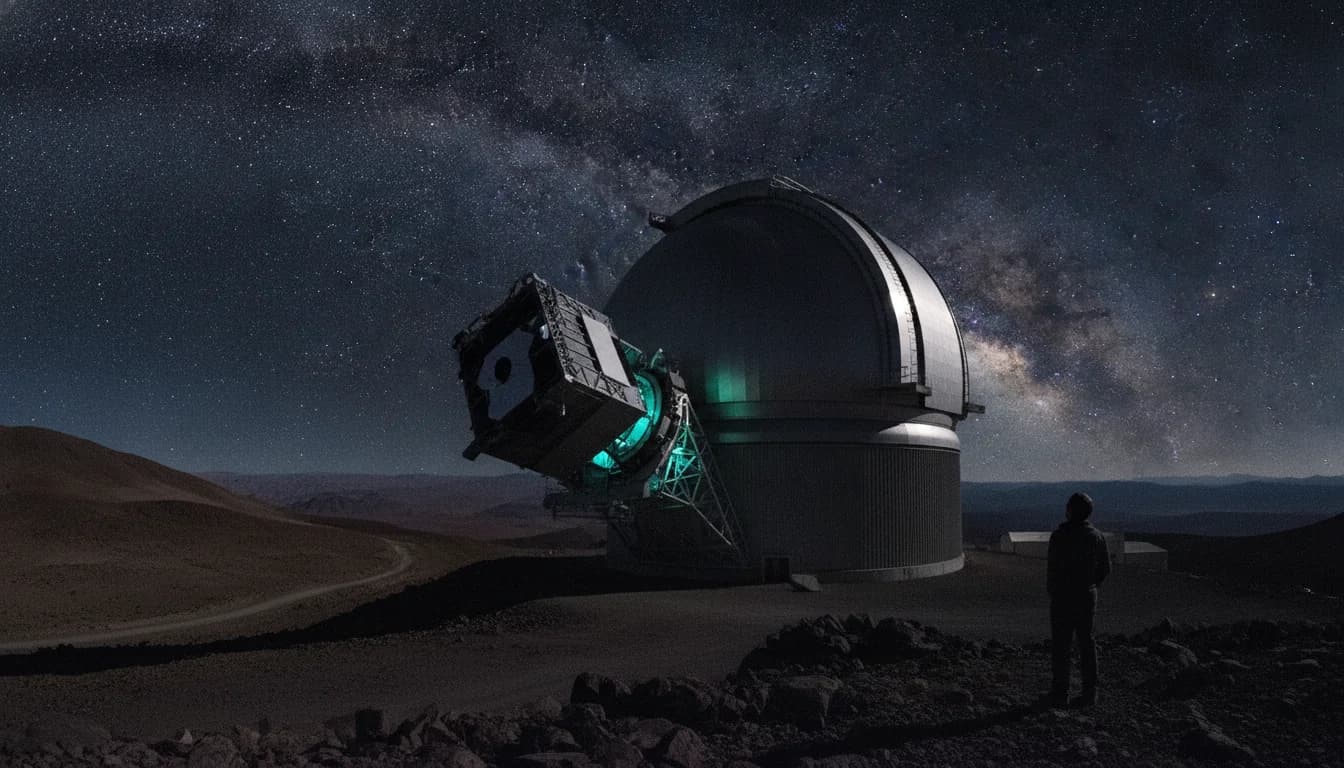
In a milestone for European astronomy, the MOONS instrument—an international project led by the UK Astronomy Technology Centre (UK ATC)—delivered what researchers describe as a Milky Way first look. The Cambridge Review confirms that the event occurred on September 3, 2026, when MOONS achieved first light in Baade’s Window, a dust‑obscured view toward the Milky Way’s bulge, using ESO’s Very Large Telescope at Paranal, Chile. This is a landmark moment for UK-led instrumentation and large‑scale spectroscopic surveys, signaling not only an engineering triumph but a data‑driven opportunity to map the Milky Way with unprecedented density and depth. The milestone underscores Europe’s role in multi‑object infrared spectroscopy and complements ongoing astrometric and imaging campaigns across the planet. (hq.eso.org)
MOONS’ first light is more than a ceremonial achievement; it is the opening of a ten‑year science program designed to census millions of stars in the Milky Way’s central regions and to conduct extragalactic surveys in parallel. As Cambridge Review notes, MOONS was designed to operate at 640–1700 nanometers with a spectral resolution range from about 4,000 to 20,000, depending on configuration, and its core multiplexing capability sits at the heart of its scientific promise. The instrument couples two identical cryogenic spectrographs—each fed by 500 fibers—so that roughly 1,000 targets can be observed simultaneously. This multiplexing scale marks a meaningful advance over many traditional single‑object spectrographs and positions MOONS to execute large, homogeneous chemo‑dynamical studies of the Milky Way while continuing to probe distant galaxies across cosmic time. (cambridgereview.uk)
MOONS achieved first light on September 3, 2026, at Baade’s Window, Paranal, the well‑established low‑extinction window toward the Galactic center. The ESO public release confirms this date and location, noting that the first light was recorded as part of the commissioning process and that the instrument is designed to observe approximately 1,000 objects at once using around 1,000 optical fibres distributed across two spectrographs. The event was observed in the presence of MOONS project leadership from the UK ATC, Italian and other European partners, and ESO representatives, highlighting a successful multinational collaboration that brings UK engineering and European science together on a high‑impact project. The first light milestone is showcased as a proof point for expanding the survey program and integrating with Gaia, VISTA, and other surveys to build a dense, 3D chemo‑kinematic map of the Milky Way. (hq.eso.org)
The Cambridge Review’s coverage frames the announcement as a turning point for Milky Way archaeology in the near‑infrared. In addition to the technical triumph, the piece emphasizes the strategic value of MOONS within Europe’s instrument portfolio and its potential to influence future multi‑object spectrograph design. The article also situates MOONS within a broader trend toward high‑multiplex spectroscopy, arguing that the combination of high throughput, near‑IR capability, and cross‑survey compatibility will accelerate the pace of discovery in both the Milky Way and the distant universe. The UK‑led consortium’s role is highlighted as a model for pan‑European collaboration that aligns science goals with engineering excellence. (cambridgereview.uk)
What happened, in detail, reveals a carefully choreographed sequence from commissioning to first science. The MOONS team completed the integration of fibres, cryogenic spectrographs, and the fibre‑positioning system, then moved into on‑sky testing at Paranal. The Baade’s Window field—chosen for its relatively low extinction and rich stellar population—served as the proving ground for the instrument’s capability to separate spectra from thousands of stars in dense fields, a task previously limited by dust obscuration and crowding in optical surveys. ESO’s release describes the Baade’s Window as the inaugural field observed, underscoring that the early science aims include measuring metallicities and radial velocities across the bulge in order to disentangle the Milky Way’s formation history. This early success is framed by a broader plan to scale up to large‑area surveys over MOONS’ ten‑year lifecycle, with data products designed to be cross‑calibrated against Gaia and near‑IR imaging datasets. (hq.eso.org)
MOONS is a flagship UK‑led instrument, but it sits within a European collaboration that includes Cambridge and INAF among others. The project’s leadership and governance structure, as outlined in UK ATC and ESO materials, reflect a deliberate strategy to couple high‑impact science with advanced instrumentation. The UK’s involvement is particularly notable because MOONS demonstrates the country’s continued leadership in next‑generation spectroscopy and large‑facility instrument development. The UKRI piece highlights MOONS as a major milestone in UK science and engineering, pointing to the consortium’s plan to harvest a decade of data that will inform models of galaxy formation and the Milky Way’s own chemodynamical history. For readers tracking technology and market trends in astronomy, the MOONS milestone exemplifies how European collaboration, funded and orchestrated through national agencies, aligns cutting‑edge engineering with bold scientific agendas. (ukri.org)
Why this matters extends well beyond the engineering room. The Milky Way, with its dust lanes and crowded bulge, has always presented a challenge to optical surveys; infrared spectroscopy is the key to decoding chemical abundances and stellar motions in regions where visible light is obscured. MOONS’ capability to obtain spectra for thousands of stars in a single exposure opens the door to high‑cadence chemo‑dynamical mapping that can test galaxy formation models with statistical rigor. Cambridge Review explicitly connects MOONS’ capabilities to constructing a three‑dimensional map of the Milky Way, linking chemical enrichment histories to dynamical heating across the bulge and inner disc. The instrument’s high multiplexing density means that what used to require hundreds or thousands of individual pointings can be achieved with coordinated, simultaneous observations, accelerating the pace at which the Milky Way’s history can be inferred from observational data. This work complements Gaia’s astrometric map and deep imaging surveys by adding the critical chemical and kinematic dimensions that only spectroscopy provides. (cambridgereview.uk)
In terms of impact on the field and stakeholders, MOONS’ Milky Way first look is emblematic of a larger shift toward integrated, cross‑facility science programs. The ability to cross‑calibrate large spectroscopic datasets with Gaia’s precise positions and motions, as well as with near‑infrared imaging surveys such as VISTA, promises a more coherent, multi‑dimensional view of the Milky Way’s assembly history. Cambridge Review highlights how MOONS can help disentangle overlapping stellar populations, distinguish migration patterns within the bulge and inner disc, and provide the velocity structures needed to understand the Galaxy’s formation timeline. This is not merely about cataloging stars; it is about building a framework for comparing observed chemo‑dynamical patterns with predictions from galaxy formation simulations, enabling a more nuanced picture of how spiral galaxies—ours included—assemble over cosmic time. (cambridgereview.uk)
The MOONS milestone also has implications for research governance and funding strategies across Europe. The partnership model—led by UK ATC, with substantial European participation—demonstrates how large‑scale instrumentation projects can be sustained through international collaboration, shared risk, and joint data governance. Cambridge Review explicitly frames MOONS as a case study in how to organize cross‑border scientific development in a way that yields tangible technological and scientific returns. For policymakers and funding bodies, MOONS provides a concrete example of how sustained investment in instrumentation translates into a durable research ecosystem capable of producing high‑impact science across multiple decades. The UKRI release further reinforces this point, pointing to MOONS’ role in advancing both galaxy evolution studies and the detailed anatomy of our own Milky Way. (ukri.org)
What’s next for MOONS is a carefully sequenced progression from commissioning to routine science operations and then into a broader slate of surveys. The timeline outlined in the ESO materials points to expanding beyond Baade’s Window to cover larger swaths of the bulge, disc, and halo, with the instrument’s ten‑year design lifetime guiding program architecture and data release plans. The next observing campaigns will likely emphasize both dense, high‑priority subfields and wide‑area mapping to maximize the scientific return from the instrument’s 1,000‑object multiplex. Cambridge Review notes that early science results are expected to feed into broader data pipelines and community‑driven analyses, while ESO and UK ATC communications emphasize the importance of cross‑calibration with Gaia and other surveys to create a cohesive, multi‑wavelength map of the Milky Way. (hq.eso.org)
Timeline and next steps, in practical terms, will be shaped by observing conditions, proposal cycles, and pipeline development. The MOONS team has signaled that first light is the signal to ramp into a broader on‑sky program, with calibration, data reduction, and reproducible pipelines as core deliverables. The ESO release highlights that the instrument’s performance will inform the construction of its data products and the exploitation of its spectral libraries, while Cambridge Review frames these developments within a larger European instrumentation ecosystem. In short, the next 12–24 months will be critical for commissioning enhancements, expanding target lists, and refining spectral libraries that will enable researchers to perform precise metallicity measurements, track stellar ages, and extract robust kinematic information across millions of stars. The collaborative infrastructure established for MOONS will also serve as a blueprint for future cross‑border, multi‑object spectrograph projects, signaling a broader shift in how astronomy research is organized, funded, and executed. (hq.eso.org)
As MOONS moves from commissioning toward a structured, long‑running science program, Cambridge Review will continue to monitor its on‑sky performance, data releases, and the broader implications for Milky Way archaeology and extragalactic surveys. The project’s ten‑year horizon implies that researchers, engineers, and policy makers will be evaluating success across multiple funding cycles, with data legacy becoming a central narrative. For readers and practitioners who follow technology and market trends in astronomy, MOONS represents a practical embodiment of how science goals translate into instrument capabilities, how cross‑disciplinary teams organize complex projects, and how a UK‑led program can catalyze European leadership in next‑generation spectroscopy. The next few observing seasons are likely to reveal not just improved spectra, but new questions—many of which will require the continued collaboration of European partners and the alignment of national research agendas with shared scientific ambitions. (ukri.org)
In closing, the Milky Way first look achieved by MOONS on September 3, 2026, at Paranal, is a milestone with both immediate and lasting significance. It demonstrates that a UK‑led, Europe‑wide instrument can perform in a crowded, dust‑obscured region of our own galaxy while delivering data products capable of informing galaxy evolution models far beyond the Milky Way. It also showcases how a large consortium can turn ambitious instrumentation into actionable science, creating a path for future multi‑object spectrographs to map the cosmos with both breadth and depth. As the data stream begins to flow, researchers and institutions around the world will be watching MOONS’ data releases and the scientific insights they unlock, which will shape our understanding of the Milky Way for the next decade and beyond. Readers should stay tuned to ESO’s official channels and UKRI’s updates for the latest milestones, program rosters, and initial science results as the first months of MOONS’ on‑sky survey unfold. (hq.eso.org)