MOONS Instrument Milky Way First Look
Cambridge Review features MOONS Instrument capturing its first look at the Milky Way with initial light observations at the VLT telescope.
 By Harriet Lockwood · 6 September 2026 · 13 min read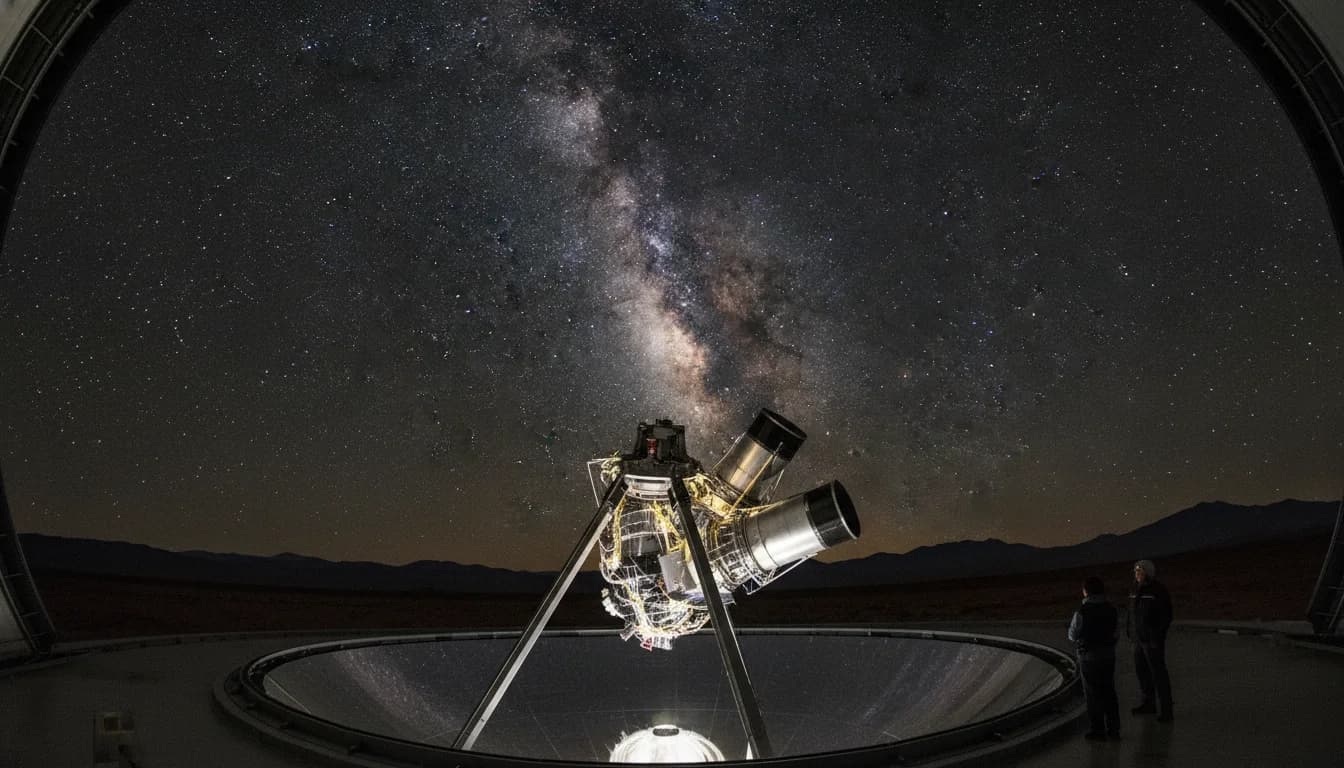
MOONS Instrument Milky Way first look marks a milestone for European astronomy as the MOONS instrument delivered its initial on-sky performance at ESO’s Very Large Telescope. On September 3, 2026, the MOONS team recorded first light from a field toward the Milky Way’s bulge, Baade’s Window, at Paranal Observatory in Chile. This event opens a new era for infrared spectroscopy in crowded, dust-obscured regions of our galaxy, where MOONS’ multiplexing capability can capture spectra from thousands of stars in a single observing run. The milestone was achieved within the European Southern Observatory framework, highlighting a collaboration that blends cutting-edge instrumentation with the science goals of Milky Way archaeology and galaxy evolution. According to ESO, the first light observation confirms MOONS’ readiness to begin its science program, moving from commissioning toward a broader on-sky survey phase. This development matters not only for Milky Way mapping but also for how astronomers approach large, multi-object spectrograph surveys in the near-infrared regime. The Milky Way first look enabled by MOONS’ capabilities provides a testbed for future large-scale spectroscopic campaigns that will complement space-based astrometry and ground-based imaging surveys. The achievement sits at the intersection of instrument engineering, data processing pipelines, and astrophysical interpretation, and it comes with a clear path toward a decade-long science program. The event also underscores Europe’s role in advancing multi-object spectroscopy as a standard tool for exploring the cosmos, from our own stellar neighborhood to the distant universe. For readers tracking technology and market trends in astronomy, this milestone signals a maturation of a class of instruments designed to tackle complex, detailed inventories of stellar populations in the Milky Way. (hq.eso.org)
MOONS Instrument Milky Way first look is the culmination of years of design work on a third-generation, multi-object spectrograph installed on the Very Large Telescope (VLT) at Paranal. The instrument’s architecture leverages a fast and highly accurate fibre-positioning system that feeds light into two identical cryogenic spectrographs, each equipped with 500 fibres, enabling the collection of optical and near-infrared spectra for about 1,000 objects simultaneously. This multiplexing capability is central to MOONS’ promise: unlocking chemistry and kinematics for millions of stars in the Milky Way while also enabling surveys of galaxies across cosmic time. The combination of MOONS with the VLT’s light-gathering power places it in a unique position to trace the chemical evolution and dynamical history of the Galaxy, complementing space-based astrometry and deep imaging surveys conducted elsewhere. The instrument’s design, development, and commissioning have been a collaborative effort across Europe and Chile, with leadership from the UK Astronomy Technology Centre and partners including INAF and Cambridge, among others. The MOONS project is positioned to observe within a wavelength range of roughly 640–1700 nm, with spectral resolution in the broad range of 4,000 to 20,000, depending on the observing mode. This capability is essential for disentangling chemical abundances, stellar ages, and motions in crowded fields near the Galactic center, where dust obscuration has historically limited optical studies. The MOONS technical specifications also emphasize a wide multiplex reach, enabling surveys that would be impractical with single-object spectrographs. The on-sky demonstration demonstrates that the instrument can operate as designed and will enable a continuous stream of data over the planned ten-year lifecycle. In short, MOONS is designed to fill a gap in Milky Way archaeology by providing the throughput and spectral resolution needed to sample millions of stars with high fidelity, all while integrating with other large surveys that map the dynamic structure of our home galaxy. This milestone sets the stage for a broad scientific agenda, from the bulge to the outer disc and halo. According to ESO, the MOONS first light observations mark the transition from commissioning to early science, with plans to progressively expand survey coverage and depth as observing programs ramp up. The instrument’s on-sky performance also promises to drive developments in data reduction and analysis pipelines that will be reused across other multi-object spectrographs in the era of large surveys. The broader implication is that MOONS will act as a galactic-scale spectroscopic census tool, providing a dense, velocity-resolved 3D view of the Milky Way and enabling unprecedented studies of stellar populations, chemical enrichment, and dynamical history. The project exemplifies how instrument-level advances unlock new scientific capabilities, ultimately translating into richer maps of our own galaxy and a deeper understanding of galaxy formation across the universe. (eso.org)
MOONS first light at the VLT Baade’s Window field confirms the instrument’s readiness for its science program and signals a new era of Milky Way astronomy. Baade’s Window is a well-known, relatively low-extinction window toward the Galactic center, a region where infrared spectroscopy can penetrate dust and reveal stellar populations that optical surveys struggle to characterize. The first field observed with MOONS focused on this area to test the instrument’s capability to obtain spectra from many stars in a crowded field, sampling key spectral features necessary to derive chemical abundances and radial velocities. ESO’s release describes Baade’s Window as the initial target, illustrating the practical approach of validating the instrument against a scientifically rich and technically challenging region of the sky. The selection of Baade’s Window demonstrates the team’s strategy to maximize immediate scientific return while establishing the reliability of the fibre-fed spectrographs and their calibration in real observing conditions. The achievement at Baade’s Window also aligns with MOONS’ broader goal to map the Milky Way’s bulge and disc, thereby contributing to a three-dimensional model of our galaxy and enabling comparisons with complementary datasets from Gaia, VISTA, and other surveys. The on-sky success in this target area provides a critical proof point for subsequent observing campaigns that will extend MOONS’ reach to fainter stars and more distant regions of the bulge and disc. The milestone is widely covered in ESO’s communications channels and is echoed in international astronomy outlets following the release. (hq.eso.org)
What Happened
MOONS first light observations
First field toward Baade’s Window
The first-sky field observed with MOONS was Baade’s Window, chosen for its relatively clear line of sight through the Milky Way’s central regions. This initial field allowed investigators to test the instrument’s fibre-fed spectrographs, calibrate the data pipeline, and demonstrate the capacity to extract spectra from dozens to thousands of stars within a single pointing. The observed field is representative of MOONS’ science objective: to map the central regions of the Milky Way in the near-infrared, where dust obscures visible light but infrared light can penetrate. The Baade’s Window target underscores MOONS’ role in complementing Gaia’s astrometric map with spectroscopy that reveals chemical composition and stellar motions. This on-sky demonstration aligns with the instrument’s stated capabilities: 640–1700 nm wavelength coverage and spectral resolution R ~ 4,000–20,000, depending on mode. The dual spectrographs and 500 fibres per arm enable tracking of spectral features for around 1,000 objects at once, offering a density of measurements that supports robust population analyses across the bulge and inner disc. Observers note that this setup is particularly well-suited to distinguishing stellar populations that have different formation histories, thereby contributing to a more nuanced view of how the Milky Way assembled over cosmic time. The first light event confirms that the hardware and software ecosystems are functioning as designed and that the instrument can begin delivering science-quality data on star-by-star scales in the Milky Way. (hq.eso.org)
Timeline and key facts
The recognition of first light on September 3, 2026 marks the formal transition from commissioning to initial science operations for MOONS. The MOONS page identifies first light as a milestone for this instrument, and the ESO press materials articulate the sequential steps from integration to on-sky testing to routine science programs. While the on-sky tests focused on the Milky Way bulge region, the broader timeline foresees expanding from the Baade’s Window field to a larger program that surveys millions of stars across the bulge, disc, and halo over the instrument’s ten-year design lifetime. The instrument’s capability to observe roughly 1,000 objects simultaneously, with two identical spectrographs and 500 fibres per spectrograph, positions MOONS to deliver statistically robust chemo-dynamical maps of the Milky Way. Moreover, the first light observations demonstrate MOONS’ performance in the near-infrared, an essential regime for penetrating dust and measuring metallicities and radial velocities in crowded stellar environments. The collaboration behind MOONS — which includes the UK Astronomy Technology Centre, INAF, Cambridge, and other European partners — emphasizes a pan-European approach to instrument development and scientific exploitation, echoing a broader pattern in modern astronomical instrumentation where cross-border teams deliver complex capabilities for large facilities. The first light milestone is thus both a technical achievement and a signal of the program’s trajectory toward large-scale Milky Way and extragalactic surveys. (hq.eso.org)
Why It Matters
Milky Way archaeology in the near-infrared
The Milky Way is a mosaic of stellar populations with a complex formation history. MOONS’ near-infrared spectroscopic capabilities enable measurements of chemical abundances and radial velocities in stars that lie behind thick dust lanes, particularly toward the bulge and inner disc. This access to dust-obscured regions is a major advance compared with optical surveys, where extinction can suppress crucial spectral features. By sampling millions of stars with relatively high spectral resolution, MOONS will contribute to the construction of a detailed, three-dimensional map of the Milky Way that encodes the Galaxy’s assembly history, including the contributions from accreted satellites and the formation of the bulge. The instrument’s design—two spectrographs, 500 fibres each, and a multiplex capability accommodating roughly 1,000 objects simultaneously—facilitates the rapid build-out of large, homogeneous datasets necessary for chemo-dynamical analyses at a Galactic scale. The Milky Way mapping objective aligns MOONS with long-standing astronomical questions about the formation and evolution of spiral galaxies, and it demonstrates how a dedicated on-site spectrograph complements space-based projects by providing high-fidelity spectroscopy in the infrared. The on-sky demonstration in Baade’s Window provides a concrete demonstration of feasibility, and it lays the groundwork for a systematic survey program that will deliver statistically meaningful results about stellar populations across the bulge and disc. The broader significance extends beyond Milky Way studies: MOONS will also perform spectroscopy of galaxies across cosmic time, connecting the local and distant universe through a common technology platform. The instrument thus sits at a nexus of Galactic archaeology and extragalactic science, illustrating how a single facility can contribute to multiple, interwoven scientific narratives. (eso.org)
Impact on the field and stakeholders
MOONS represents a major enhancement for Milky Way archaeology by enabling near-infrared, high-multiplex spectroscopy that complements Gaia’s astrometry and deep imaging surveys. In the MgC (Milky Way Chemistry) domain, the new data streams will help astronomers disentangle the stellar populations that constitute the bulge, thick disc, and inner thin disc, illuminating migration patterns, enrichment histories, and dynamical processes that shaped the Galaxy’s present structure. By providing high-quality radial velocities and chemical abundances across a wide swath of the inner Galaxy, MOONS will reduce degeneracies in Galactic models and enable more precise reconstructions of the Milky Way’s growth over billions of years. The field stands to gain from improved cross-calibration opportunities with Gaia, VISTA, and complementary spectroscopic surveys, creating a cohesive, multi-wavelength framework for mapping the Milky Way. The collaboration behind MOONS emphasizes an integrated effort across institutions and countries, positioning Europe as a leader in next-generation, multi-object spectroscopy and in the broader science ecosystem surrounding large facilities like the VLT. This collaborative model has implications for other instrument projects, which increasingly rely on pan-regional partnerships to deliver high-impact science programs. The Milky Way first look serves as a tangible demonstration of what coordinated, cross-institutional efforts can achieve when pushing the boundaries of instrument capability and data analysis pipelines. (eso.org)
The broader scientific and market context
In the broader context of astronomical instrumentation, MOONS fits into a trend toward multiplexed spectrographs capable of capturing rich datasets, enabling more comprehensive statistical analyses of stellar populations and galaxy properties. The instrument’s design embodies the shift from single-target spectroscopy to high-throughput, targeted spectroscopic surveys that can be synchronized with wide-field imaging and astrometric datasets. This shift has implications for research funding, project management, and the commercialization of high-precision fibre positioning technologies and cryogenic spectrograph components. By delivering on its engineering promises, MOONS helps validate a model of multi-object spectroscopy that can scale to future facilities and complementary missions, potentially influencing how funding agencies structure calls for new instruments and how academic and national laboratories collaborate on complex, long-horizon projects. The Milky Way first look is thus not only a scientific milestone but also a case study in the evolving economics and governance of large-scale astronomical instrumentation. (eso.org)
What’s Next
Expanding the Milky Way survey and science programs
With first light achieved, MOONS will progressively scale its observing programs to cover broader regions of the Milky Way, extending from the bulge through the inner disc and into less-dense outer regions. The instrument’s capability to observe about 1,000 objects at a time means that expansive surveys can be conducted more efficiently than with previous generations of multi-object spectrographs. In practical terms, this translates to more rapid accumulation of metallicity distributions, stellar ages, and kinematic profiles across millions of stars, enabling more precise models of chemical evolution and dynamical heating in the Milky Way. The on-sky readiness demonstrated by Baade’s Window provides a proof of concept for more ambitious campaigns that will branch into targeted sub-samples—such as specific stellar populations, age cohorts, or regions with distinct star-formation histories. As MOONS shifts from commissioning to routine science, researchers anticipate a steady cadence of data releases that will feed into global efforts to cross-calibrate spectroscopic surveys with Gaia’s astrometric measurements and with near-infrared imaging campaigns from VISTA and other facilities. The collaboration’s ten-year lifespan promises a long horizon for observing programs, pipeline improvements, and community-driven data analyses. The milestones ahead include expanding target lists, refining spectral libraries, and delivering accessible data products that enable both large-scale population studies and detailed, star-by-star investigations of the Milky Way’s central regions. In this sense, MOONS will become a cornerstone instrument for Milky Way archaeology and a touchstone for future multi-object spectrographs at next-generation facilities. (eso.org)
What readers should watch for
Observers and analysts should monitor a few key indicators as MOONS scales up its science operations. First, the cadence and depth of early data releases will reveal how quickly the team can build a uniform, high-quality chemo-dynamical map of the Milky Way’s bulge and inner disc. Second, the data-quality metrics, including spectral signal-to-noise ratios across the multiplexed fibres and the stability of wavelength calibration in near-infrared bands, will indicate readiness for progressively fainter targets. Third, MOONS’ integration with Gaia and complementary surveys will be assessed in terms of cross-match completeness and consistency of chemical abundance scales, which are critical for coherent Galactic archaeology analyses. Finally, the instrument’s operational performance, including fibre positioning accuracy, instrumental throughput, and environmental stability at Paranal, will influence planning for subsequent observing runs and the prioritization of key science programs. In addition to Milky Way science, MOONS’ capabilities will enable substantial extragalactic studies, including spectroscopy of distant galaxies during their peak star-formation epochs, which will test the robustness of the instrument in a broader scientific context. The next few observing cycles are expected to yield the first multi-object spectra across diverse Galactic environments, setting the stage for a comprehensive, long-term data legacy. (eso.org)
Closing
MOONS’ Milky Way first look marks a significant inflection point for on-sky spectroscopy in dust-obscured regions of our galaxy. The successful first light at the VLT on September 3, 2026 confirms the instrument’s readiness to begin a structured, long-term survey program that will deliver a dense chemo-dynamical map of the Milky Way. As data begin to flow from Baade’s Window toward broader Galactic coverage, researchers will be able to integrate these spectroscopic measurements with Gaia’s astrometry and VISTA’s imaging to construct a more complete narrative of how the Milky Way formed and evolved. The milestone also signals broader momentum in European astronomical instrumentation, highlighting how coordinated development across institutions can yield powerful tools for both Milky Way science and extragalactic exploration. Readers seeking ongoing updates can monitor ESO’s announcements and partner institutions for forthcoming data releases, program rosters, and first-look science results, which will gradually illuminate the intricate history encoded in the stars of our own galaxy.
The Milky Way first look is a reminder that the next era of astronomical discovery will be defined not only by new telescopes, but by the instruments that turn photons into physics. MOONS stands at the intersection of engineering, computation, and science policy, offering a practical pathway to map the Milky Way in three dimensions and to extend humanity’s observational reach into the near-infrared, where the galaxy’s hidden stories await. As MOONS continues its commissioning-to-science arc, Cambridge Review will follow the program’s trajectory, tracking how the data, analyses, and collaborations evolve to produce actionable insights about our Galaxy and the broader cosmos. (hq.eso.org)