CosmoCube Cambridge Funding for Lunar Mission
Discover the latest data-driven insights on CosmoCube Cambridge's funding efforts for their lunar mission and the exciting UK collaborative initiatives.
 By Thomas Whitfield · 31 August 2026 · 11 min read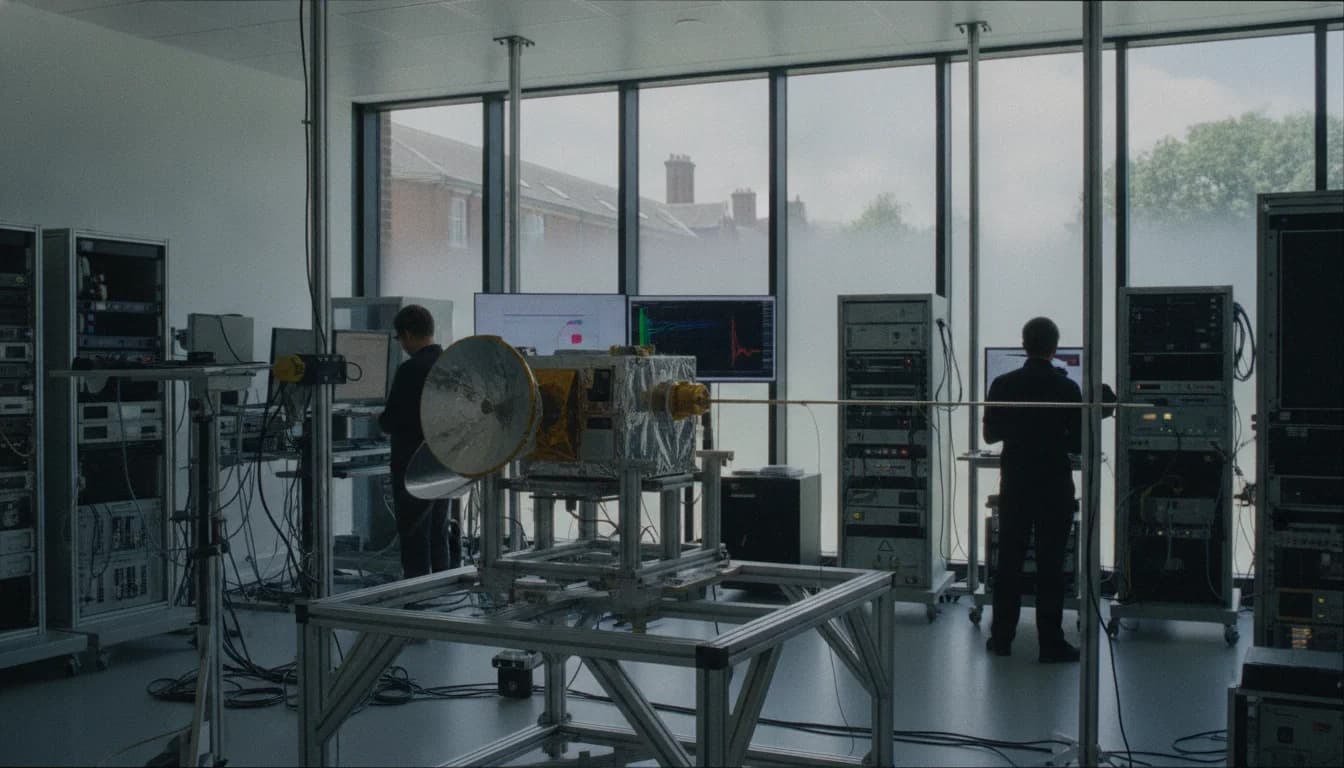
In a development that underscores the United Kingdom’s active role in international lunar science, CosmoCube is moving from concept to a funded research program with Cambridge as a leading partner. The funding sits within a broader UK Space Agency initiative designed to bolster global science and exploration collaborations with NASA, ISRO, CSA, JAXA, and others. The announcement, which situates CosmoCube within a suite of bilateral projects, marks a significant milestone for the Cambridge ecosystem and its network of academic and industry collaborators. This comes as CosmoCube is positioned to study the early universe from lunar orbit, using a small, cost-efficient radiometer to probe 21-cm cosmology signals from the cosmic dark ages and the cosmic dawn. The funding, timeline, and partnership structure are shaping a path toward a sister set of missions that could redefine cosmological observations from the lunar farside. This overview synthesizes what happened, why it matters, and what readers should watch next as Cambridge’s lunar mission moves deeper into development. CosmoCube Cambridge funding for lunar mission is central to this coverage, and it anchors a data-driven view of UK space science investment and its global implications. (gov.uk)
In the meantime, Cambridge researchers are aligning with a global cadre of partners to turn a concept into a testbed for cosmology from the Moon. The CosmoCube project—a compact radiometer payload intended for a small satellite in lunar orbit—has become a focal point for lessons about low-frequency radio astronomy, interference mitigation, and the practicalities of planning a mission intended to observe faint signals from the universe’s earliest epochs. The work is grounded in a UK-led international consortium spanning the Cavendish Laboratory at Cambridge, the Kavli Institute for Cosmology Cambridge, the University of Portsmouth, and industry collaborators like SSTL, with NASA involvement positioned to amplify the mission’s science goals. This growing collaboration is the backdrop for a broader national strategy to catalyze international partnerships around ambitious space science projects. The initiative is part of a broader portfolio of bilateral programmes designed to share expertise, hardware, and data across borders. (phy.cam.ac.uk)
What Happened
Funding announcement and initial allocation
CosmoCube was singled out in a major bilateral funding round as a Cambridge-led element of the UK Space Agency’s Space Science and Exploration Bilateral Programme. In a formal government release dated February 14, 2024, the programme announced UK funding to Cambridge and NASA for CosmoCube, specifying an allocation of £1.5 million for Cambridge’s leadership of the project, payload development, and associated science activities. This investment formed part of a £7.4 million package across several projects under the bilateral scheme, illustrating a coordinated push to advance UK cosmology and lunar exploration capabilities through international collaboration. The CosmoCube line was explicitly listed as “CosmoCube (University of Cambridge and NASA, USA) - £1.5 million” in the agency’s project roster. The release highlighted that these bilateral projects are designed to deepen UK participation in international missions and to cultivate capabilities that could benefit future space science endeavors. Published on February 14, 2024, the document provides the foundational funding context for CosmoCube’s development. (gov.uk)
Phase 1 of the CosmoCube program has continued to unfold under that initial funding, with Cambridge-centric leadership and a plan to mature the mission profile for a path to launch. The COSMOCube project is part of a broader effort in which UK researchers collaborate with multiple international partners to develop instruments, flight systems, and science payloads suitable for a lunar environment. The government’s bilateral programme has since evolved through subsequent funding cycles and collaborative milestones that reinforce the role of Cambridge as a hub for cosmology-focused space science. These updates are reflected across Cambridge and partner institutions, including Kavli Institute for Cosmology Cambridge and STFC RAL Space, which situate CosmoCube within a sustained trajectory of development and international partnership. (nature.com)
Phase 0 study and industry collaboration
A notable milestone in CosmoCube’s maturation occurred with the Phase 0 study, officially described as starting in April 2025. Surrey Satellite Technology Ltd (SSTL) reported that the Phase 0 study—led by Cambridge University as the grant holder—opened a focused evaluation of platform configurations, payload integration, and cost/time estimates for a non-cubesat configuration. The Phase 0 effort is designed to refine the mission concept, validate radiometer technology, and establish a credible case for the broader Space Science and Exploration Bilateral Programme’s support. The 3-month study marks a concrete transition from concept to engineering activities and prepares the team for a more detailed design phase. The public briefing confirms Cambridge’s role as the primary grant holder and identifies collaboration with Portsmouth University and RAL Space as part of the CosmoCube consortium. (sstl.co.uk)
Follow-on funding and ongoing updates
The CosmoCube project has continued to attract and receive funding within the UK’s space science ecosystem. Updates from Cambridge and partner institutions describe additional UK Space Agency support aimed at accelerating mission development, refining the radiometer payload, and advancing the platform for lunar orbit operations. A recent round of updates highlighted a targeted funding boost in late 2024 to early 2025, aimed at mission development and testing activities for the CosmoCube payload and thermal control systems. These increments are part of the UK’s broader strategy to sustain momentum on CosmoCube while ensuring alignment with international partners and mission readiness milestones. The funding additions are framed as enabling deeper work on a path toward a lunar mission with a clear scientific objective. These updates align with the public statements from partner institutions and with statements from UK Space Agency representatives about the bilateral program’s ongoing support. (cosmocube.net)
The CosmoCube concept in the scientific literature
Beyond government and institutional announcements, CosmoCube has been featured in peer-reviewed and professional outlets as a cost-effective approach to observing the 21-cm hydrogen line from lunar orbit. A Nature Astronomy article published in 2026 outlines the conceptual framework for the CosmoCube mission as a low-cost radiometer designed to probe spectral distortions in the cosmic microwave background from the Moon’s far side. The article emphasizes the scientific potential of placing the radiometer in lunar orbit to exploit the radio-quiet environment away from Earth-based interference, thereby enabling observations that are difficult from Earth or near-Earth space. The publication frames CosmoCube as a timely proposal that leverages UK leadership and international collaboration to advance cosmology. While access to full content may require institutional subscriptions, the abstract and cited figures underscore the mission’s core scientific rationale and the importance of the lunar farside environment for low-frequency radio astronomy. (nature.com)
Cambridge-specific context and academic leadership
Cambridge’s own institutional communications have reinforced the narrative of CosmoCube as a flagship project for cosmology on the Moon. The Cavendish Laboratory and Kavli Institute for Cosmology Cambridge have published articles highlighting the mission’s aim to illuminate the Universe’s Dark Ages and Cosmic Dawn through a miniature radiometer in lunar orbit. These campus-level communications note strategic partnerships with Portsmouth and STFC RAL Space, and they emphasize the project’s role in training the next generation of scientists and engineers in space instrumentation and mission design. The Cambridge materials also point to the involvement of industry partners, such as SSTL, in developing the space platform and mission architecture, which underscores the translational potential of CosmoCube for both research and commercial spaceflight ecosystems. (phy.cam.ac.uk)
Why It Matters
Scientific impact and cosmology advances
CosmoCube’s central scientific goal—probing the 21-cm hydrogen signal from the dark ages and cosmic dawn—addresses a long-standing gap in observational cosmology. Ground-based observations struggle with radio frequency interference and atmospheric limitations, particularly at the very low frequencies where the dark ages signal would lie. A far-side lunar mission would, in theory, provide a radio-quiet platform to observe faint cosmological signals that could refine constraints on the early universe’s evolution, the behavior of dark matter, and the timeline for the first luminous structures. The Nature Astronomy presentation of CosmoCube emphasizes that observing from lunar orbit could deliver high-sensitivity data across a critical redshift range, helping to anchor models of cosmic evolution and test hypotheses about the early universe’s structure formation. The scientific payoff—if realized—extends beyond cosmology to inform fundamental physics and potentially reveal new aspects of the Universe’s history. (nature.com)
Economic and strategic value to the UK
From a policy and economic perspective, CosmoCube represents more than a single mission; it signals the UK’s commitment to maintaining leadership in space science through international collaboration. The UK Space Agency’s bilateral programme structure is designed to mobilize university researchers, national laboratories, and industry firms to co-develop payloads, platforms, and mission concepts that align with global partners. The February 2024 government release explicitly framed CosmoCube as part of a broader strategy to immerse UK science in international missions, with funding packages linked to direct collaboration with NASA and other space agencies. The public materials stress that such investments catalyze further international investment in the UK space sector and foster knowledge exchange across borders. The emphasis on a Cambridge-led effort, supported by partners including the Kavli Institute for Cosmology Cambridge and SSTL, illustrates a model where academic leadership pairs with industry and international agencies to advance a shared scientific agenda. (gov.uk)
Implications for Cambridge and its ecosystem
Cambridge’s ecosystem—comprising universities, research institutes, and high-tech industry—stands to gain from CosmoCube in several ways. First, there is the instructional and research benefit of participating in a real mission, which enhances the training of students and early-career researchers in space instrumentation, data analysis, and mission engineering. Second, collaboration with industry partners like SSTL exposes Cambridge to mature space hardware development pipelines, potentially accelerating technology transfer and spinoff opportunities. Third, the partnership with NASA and other international agencies expands Cambridge’s network, potentially unlocking future joint programs and funding streams. Finally, the visibility of CosmoCube in prestigious outlets and university channels helps attract talent, funding, and policy attention to UK cosmology and radio astronomy in space. The combination of academic leadership, industry involvement, and international collaboration positions Cambridge as a central node in a growing constellation of lunar and cosmology-driven research initiatives. (phy.cam.ac.uk)
Global context and policy environment
CosmoCube sits within a global context of renewed attention to lunar science and international partnerships around small-satellite cosmology and instrumentation. The UK’s bilateral framework connects Cambridge-led science with NASA’s broader lunar and deep-space programs, while also coordinating with other space agencies to explore resource utilization, lunar spectroscopy, and remote sensing. The government and institutional materials emphasize that these collaborations are not merely symbolic; they are intended to yield tangible science outputs, validated instruments, and a robust pipeline for future joint missions. As CosmoCube evolves, it will likely continue to influence UK policy direction on space science, international collaboration, and the role of academia-driven projects in national space strategy. (gov.uk)
What's Next
Roadmap to launch and near-term milestones
Cambridge and its CosmoCube partners describe a multi-year, phased approach toward a lunar-orbit mission. The Cavendish Laboratory and collaborating institutions outline a roadmap spanning roughly four to five years from the current planning horizon, with a targeted goal of reaching lunar orbit by the end of the decade. The roadmap includes continued technology maturation for the radiometer payload, further phase studies, system-level design reviews, and integration with the selected space platform (likely a partner platform provider like SSTL). This sequence reflects a disciplined design, test, and integration cycle typical of small satellite cosmology missions and aligns with the UK Space Agency’s expectations for cost-effective, scientifically valuable CubeSat-derived systems. While individual milestones are contingent on funding cycles and technical progress, the core trajectory is clear: develop, test, validate, and move toward flight readiness with international collaboration serving as a critical accelerant. (phy.cam.ac.uk)
Next steps for funding, partnerships, and governance
As CosmoCube progresses, expect continued funding alignment with the Space Science and Exploration Bilateral Programme, along with potential expansions of partnership scope. Cambridge’s leadership role will require ongoing coordination with university partners, industry vendors, and international agencies, ensuring that payload development, radiometer calibration, and mission operations remain synchronized with the evolving mission design. Governance will likely emphasize risk management, cost containment, and data-sharing protocols that satisfy both UK oversight and international partners’ requirements. Given the program’s public-facing nature, updates are anticipated to occur through university news channels, UK Space Agency press releases, and partner institution communications, with formal milestones tied to technical readiness reviews, design reviews, and contract increments with industry suppliers. (phy.cam.ac.uk)
What to watch for in the near term
Observers and stakeholders should monitor a few key indicators in the months ahead. First, any formal design reviews or system-level test results related to the CosmoCube radiometer and platform integration would signal technical maturation. Second, new sums or adjustments to UKSA bilateral funding for CosmoCube and related projects would indicate ongoing financial momentum and program confidence. Third, public-facing updates from the Cambridge Kavli Institute or Cavendish Laboratory about Phase 1 or Phase 2 milestones would mark transition points from planning to implementation. Finally, independent research articles or conference presentations that detail the mission concept, instrumentation challenges, and observational forecasts will help the public and the scientific community gauge the practical feasibility and potential scientific yield of CosmoCube. The Nature Astronomy article and institutional materials provide a baseline for understanding the scientific expectations, while the government and university pages offer a window into programmatic progress and funding dynamics. (nature.com)
Closing
Cambridge’s CosmoCube initiative represents more than a single research project; it is a signal of how national science agendas, international collaboration, and industry partnerships can combine to advance cosmology from the lunar farside. The initial £1.5 million UK Space Agency funding in February 2024 established a clear financial mandate, and subsequent Phase 0 activities in 2025 demonstrated that the program was moving from concept toward a flight-analog reality. As the mission progresses, CosmoCube’s story will illuminate how cost-conscious, high-impact cosmology experiments can be designed to ride the lunar frontier’s unique advantages while engaging a diverse ecosystem of researchers, engineers, and institutions. For readers who track technology and market trends, CosmoCube embodies a model for how data-driven science initiatives can be funded, managed, and scaled across borders to yield ambitious scientific returns. Stay tuned to Cambridge Review’s coverage as CosmoCube’s milestones unfold, with updates from Cambridge, Portsmouth, SSTL, and NASA signaling the project’s next phases and their implications for space science in the UK and beyond. (gov.uk)