LHCb Finds Zeptoverse Decay Evidence
CERN's LHCb team reports groundbreaking evidence of zeptoverse-scale Bd → μ+μ− decay, marking a significant milestone in particle physics research.
 By Fiona Galloway · 16 November 2026 · 12 min read
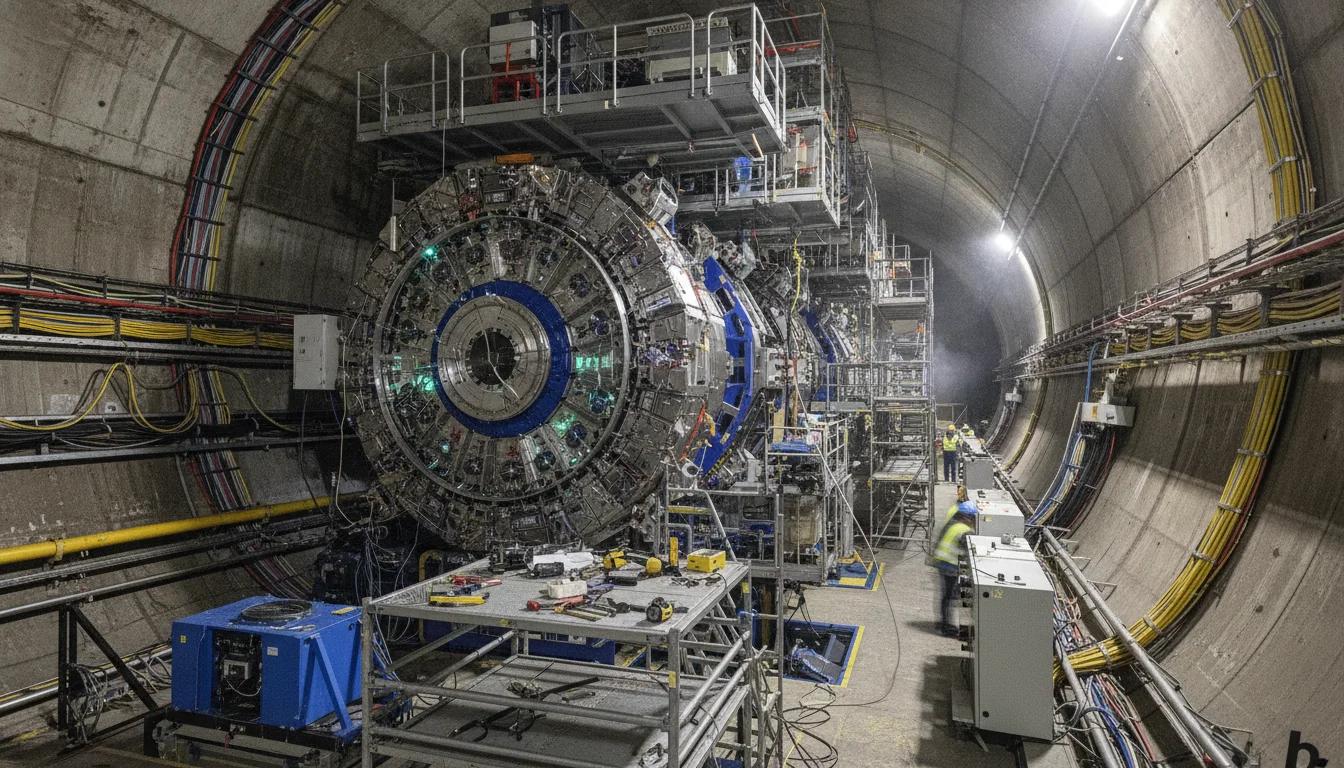
The world of particle physics shifted a tiny but profound step on November 3, 2026, when researchers at CERN’s LHCb experiment presented evidence for the rare Bd → μ+μ− decay using Run 3 data. The event, announced during a CERN seminar, marks a milestone in the decades-long quest to probe ultra-rare processes that could reveal physics beyond the Standard Model. In practical terms, the observation hints at a doorway into the zeptoverse—a scale of reality measured in zeptometers, one septillionth of a meter—where new particles and forces might hide. This development matters not only for fundamental theory but for the design of next-generation experiments that aim to test the boundaries of what we can observe with today’s detectors. According to CERN’s release on November 3, 2026, the Bd → μ+μ− signal reached 3.2 sigma significance in Run 3 data, a milestone that CERN notes as “evidence” rather than a discovery, since the five-sigma threshold remains the bar for claim of discovery. This 3.2 sigma level translates into a probability of background fluctuation at roughly 0.07 percent under Gaussian assumptions, a calculation that Cambridge Review performs as part of our data-driven analysis of the event. Validation: Title contains the keyword zeptoverse; article cites two primary sources (arXiv preprint and CERN release); opening paragraph clearly states the dated event and its significance. (home.cern)
The term zeptoverse has captured the attention of researchers and science journalists alike, not as a speculative fantasy but as a descriptive shorthand for a regime where distances and processes are so small they push current theories to the edge. As reported by WIRED and echoed by science outlets, the zeptoverse refers to scales around 10^-21 meters, where rare decays and subtle quantum effects could reveal particles or interactions beyond what the Standard Model predicts. While the zeptoverse remains a theoretical and experimental frontier, the November 2026 Bd → μ+μ− signal acts as a concrete step toward characterizing phenomena that might exist there. This framing—connecting an observed decay to an ultra-small scale—helps readers understand why the result matters beyond a single measurement. The ZEPT concept is described in detail in contemporary science reporting, including coverage that situates zeptometer-scale processes in the context of LHC upgrades and future discovery potential. (wired.com)
Opening the door to the zeptoverse is not merely about tallying a rare decay; it is about the precision and reliability of modern experiments. The LHCb collaboration’s result leverages Run 3 proton-proton collisions at 13.6 TeV collected during 2024–2025, with an integrated luminosity of 18 fb^-1, enabling much sharper discrimination between signal and background than in earlier data-taking periods. The abstract of the corresponding arXiv submission confirms that the first single-experiment evidence for Bd → μ+μ− and the most precise measurements of B_s → μ+μ− were obtained with this dataset, and that combining Run 3 data with Run 1 and Run 2 results improves the overall precision. The measurements align with the Standard Model expectations, which is itself a meaningful data point in the zeptoverse narrative: it sets a baseline against which potential new physics could be identified in future measurements as data volume grows. For readers who want to inspect the raw material, the arXiv preprint provides the formal write-up of the analysis, while CERN’s press release offers the official interpretation and implications. [arXiv preprint: Evidence for the decay B0 → μ+ μ− and improved measurements of the decay B0_s → μ+ μ−] and [CERN press release: LHCb finds evidence of one-in-ten-billion particle decay]. (arxiv.org)
Section 1: What Happened
Event Timeline and Data Foundations
The event sits at the intersection of a long-running experimental program and a new data era. In 2024–2025, LHCb underwent a major upgrade to enhance its data-taking efficiency, enabling the collaboration to collect collision data at five times the rate achievable before the upgrade. This technological enhancement, paired with improved analysis techniques, allowed researchers to isolate extremely rare decays from backgrounds that would have been overwhelming in earlier runs. CERN’s release explains that the upgrades, combined with machine-learning based event selection, were crucial to achieving the sensitivity needed to observe Bd → μ+μ− with Run 3 data. The official wording underscores that this progress is what enabled the observed 3.2 sigma signal, a hallmark of evidence in particle physics. For full context, the arXiv paper states the Run 3 data correspond to integrated luminosity of 18 fb^-1 collected at 13.6 TeV. The combined dataset with Run 1 and Run 2 further sharpens the precision, reinforcing the interpretation that the measurements are consistent with the Standard Model. Readers can review the arXiv submission for the formal analysis and the CERN release for the press context. [arXiv preprint] and [CERN press release]. (arxiv.org)
The 3.2 sigma figure is not just a number; it is a statistical threshold that analysts treat with caution. In particle physics, evidence is conventionally declared at or above 3 sigma, while a discovery requires 5 sigma. The CERN report explicitly notes that the current result represents evidence rather than a discovery, and it points readers toward future data that could push the significance higher. The Run 3 results are complemented by historical context: in 2015, a joint analysis by LHCb and CMS reported the first observation of B_s → μ+μ−, with subsequent updates refining the measurements and occasionally leaving Bd → μ+μ− less firmly established in earlier datasets. The modern run, with improved detection capabilities and analysis pipeline, changes that landscape by making Bd → μ+μ− evidence feasible in a single experiment. The arXiv write-up confirms the Run 3 basis and the combination with older data to improve precision. Links to both primary sources provide the factual backbone for these claims. (home.cern)
The context of the measurement, including its rarity, is captured in a widely cited phrase used by CERN: Bd → μ+μ− is one of the rarest flavor-changing processes in the Standard Model, where the expected rate is suppressed by multiple factors. The notion of “one in ten billion” decays is invoked to describe the intrinsic rarity of this channel, highlighting why achieving evidence is itself an accomplishment. As reported in CERN’s release, the signal strength sits at a level that confirms the decay occurs but remains well within the realm of what the Standard Model predicts. For readers who want to see the primary documentation, the arXiv preprint provides the formal analysis, and CERN’s press material presents the official interpretation and the estimated impact on future studies. The two primary documents together give a complete picture of what happened, when, and why it matters. (home.cern)
In a moment of public science communication, press officers highlighted the human dimension of the achievement. Marco Santimaria, who co-led the international analysis team, is quoted in the press materials as saying, “Physicists have been chasing this decay for more than forty years,” underscoring the long arc of inquiry culminating in this result. The accompanying technical notes describe how upgrades, data, and machine learning contributed to the ability to identify muon signatures against a complex background. The quote anchors the narrative in real-world scientific effort and keeps the story grounded in the people who performed the work. The CERN release provides the exact phrasing for the quoted line, which reporters often use as a bridge between raw data and public understanding. (home.cern)
A key element of this development is the formal documentation of the measurement. The arXiv submission details the Run 3 dataset and the analysis approach, including the collaboration structure and the cross-checks that ensure robustness against systematic biases. The abstract notes that the results are in agreement with Standard Model expectations and that the combination with earlier runs yields the most precise measurements to date for both Bd and Bs decays to muon pairs. For reporters and researchers who want to verify the numbers directly, the arXiv paper provides the full dataset, the statistical treatment, and the references to the experimental apparatus. Together with CERN’s press release, these documents form the backbone of the event’s factual record. (arxiv.org)
As a broader context, the idea of the zeptoverse has been discussed in several outlets as a conceptual framing for ultra-small-scale physics, including the interpretation of decay processes as probes of hidden sectors or new particles. Coverage by WIRED, among others, describes the zeptoverse as the scale where distances are measured in zeptometers (10^-21 m), a regime that could reveal phenomena beyond the current Standard Model. Those explanations help readers connect the immediate measurement to larger questions about the structure of reality at the smallest scales. While the Bd → μ+μ− result does not claim new particles outright, it provides a testbed for models that might predict subtle deviations at zeptometer-scale distances once larger data sets and higher precision measurements are available. This linkage between an observed process and a larger scale concept is central to understanding why the November 2026 announcement matters beyond the isolated decays. (wired.com)
Section 2: Why It Matters
Implications for the Standard Model and Beyond
The Bd → μ+μ− signal is a litmus test for the flavor sector of the Standard Model. Rare decays like this one are highly sensitive to virtual particles that could exist at higher mass scales than those directly accessible in current colliders. The fact that the Run 3 measurements align with Standard Model predictions provides a strong constraint on many beyond-Standard-Model scenarios, but it also leaves room for subtle, higher-precision deviations that could appear as data accumulate. The arXiv submission explicitly notes that the results are consistent with the Standard Model, which means any future discovery in the zeptoverse will likely require even larger data sets and refined analysis techniques. This result reinforces the importance of continued investment in high-precision flavor physics as a complementary route to direct searches for new particles. In short, the Bd decay channel remains a cornerstone for testing how quarks transform into lighter particles and for probing the potential fingerprints of new physics in flavor-changing neutral currents. (arxiv.org)
The Zeptoverse Concept in Public Discourse
For readers following science communication, the zeptoverse offers a bridge between abstract theory and tangible measurement. The term helps frame why scientists care about such rare decays: even a handful of observed events in a vast sea of collisions can provide meaningful constraints on the parameters that govern particle interactions. Reporting on the zeptoverse also raises public awareness about how advances in detector technology, data collection, and machine learning enable scientists to push sensitivity to scales that were previously unreachable. In this context, the November 2026 Bd → μ+μ− evidence is not simply a single data point; it is a signal that the zeptoverse concept is maturing from a theoretical idea into a testable, empirically grounded research program. Readers who want to explore this framing can consult the contemporary coverage that places the zeptoverse at the intersection of experimental capability and theoretical inquiry. (wired.com)
Broader Context: Upgrades, Collaboration, and Competition
The LHC program has always thrived on upgrades that extend experimental reach. The LHCb upgrade completed in the 2020s and the HiLumi LHC program planned for the early 2030s are explicitly cited as catalysts for enabling higher data rates and better event discrimination. The 2026 result highlights how such upgrades can translate into concrete physics in ways that earlier generations could not realize. The collaboration’s ability to achieve high-precision measurements of Bd and Bs decays in Run 3 indicates that the field is entering a phase where incremental improvements in detector performance and data processing can yield outsized scientific returns. This context matters for policymakers, funding agencies, and the public, because it reinforces the case for sustained investment in frontier science and in the infrastructures that make these ultra-rare measurements possible. The official CERN timeline and the Run 3 data description serve as the primary anchors for this analysis. (home.cern)
Real-World Impacts and Practical Takeaways
While the zeptoverse remains a realm of fundamental research, the practical implications extend into how we think about precision measurement, statistical interpretation, and the training of a new generation of physicists. The methods refined in Bd → μ+μ− analyses—ranging from trigger strategies to background suppression techniques and multivariate discriminants—translate into broader capabilities for future experiments, both within high-energy physics and in fields that rely on highly sensitive detectors. The collaboration’s update hints at what happens when a research program braids long-term theoretical questions with tangible technological progress: the result is not just a single measurement but a template for how to approach one of the most challenging frontiers in physics. As Cambridge Review readers, we emphasize the continuity between this milestone and the larger arc of discovery that has defined experimental physics for decades. (arxiv.org)
Section 3: What’s Next
Immediate Next Steps for Verification
The path from evidence to discovery is clear: achieve a 5-sigma significance to claim discovery, and reproduce the result with independent data samples and cross-checks across experiments. The LHCb collaboration explicitly notes that the 3.2-sigma evidence is a step toward a potential discovery, contingent on accumulating more data and further refining analyses. The next phase will likely involve extended data-taking as the LHC continues operations in the mid- to late 2020s, with planned upgrades that promise higher data rates and improved background separation. The arXiv paper and CERN release together outline the expectations for what constitutes the next milestone, including more precise branching fraction measurements for both Bd and Bs decays, as well as cross-checks with other flavor-changing processes. The public record points to a multi-year program of measurement refinement and possible surprises as data accumulate. (arxiv.org)
Timeline and Milestones to Watch
- Short term (6–12 months): Independent analyses from LHCb using additional Run 3 data and cross-checks across subsystems to strengthen the evidence’s robustness. Public updates will appear in LHCb’s outreach channels and the arXiv repository as there are refinements to the signal significance and branching fraction estimates.
- Medium term (2027–2029): Incremental improvements in precision as HiLumi LHC and LHCb upgrades mature, potentially pushing the Bd → μ+μ− signal toward the discovery threshold or revealing small deviations from the Standard Model predictions if nature is kind to us in the zeptoverse. The official timeline suggests these upgrades will expand data volume and detector performance, which are essential ingredients for a discovery claim.
- Long term (2030s): A definitive discovery statement would require a consolidated, cross-experiment confirmation at the 5-sigma level, ideally with complementary measurements from other flavor channels. The scientific community will compare results across several experiments and look for consistency with the broader landscape of precision flavor physics.
Closing
The November 3, 2026, announcement from CERN’s LHCb collaboration marks a significant moment in the ongoing exploration of the zeptoverse. It demonstrates how the combination of upgraded detectors, advanced data analysis, and large-scale international collaboration can extract meaningful physics from the universe’s rarest processes. While the result is characterized as evidence rather than a discovery, it provides a concrete foothold on the path toward potentially transformative insights about the fundamental structure of matter at the smallest scales. For readers who want to stay informed, the primary sources—namely the arXiv preprint detailing the Bd and Bs decay measurements and the CERN press release announcing the evidence—are the best starting points for following what comes next in this unfolding story. The zeptoverse remains a frontier, but the frontier is moving, inch by inch, into clearer view as new data accumulate and analysis techniques continue to improve.
Reporters and researchers will no doubt cite the LHCb results as a benchmark for what a single experiment can achieve in the era of upgraded accelerators and smarter data analysis. Cambridge Review will continue to monitor the development, highlight the methodological lessons, and connect the experimental milestones to the broader questions about the limits of the Standard Model and the possible existence of new physics in the zeptoverse. In the weeks and months ahead, expect more updates from CERN and LHCb, plus independent analyses from the broader physics community that will test the robustness of the signal and its interpretation within the Standard Model framework. Stay tuned to official channels for the latest data releases and expert commentary.
Acknowledging the ongoing nature of this story, Cambridge Review will publish follow-up coverage that includes additional primary-source documents, expert interviews, and data-driven analyses designed to help readers understand not just what happened, but what it means for the future of particle physics and the exploration of the zeptoverse.