CrSb Magnetism Cambridge: Altermagnetism Confirmed
CrSb magnetism Cambridge reports bulk altermagnetism in CrSb, mapping a 3D g‑wave order parameter and signaling new spintronic possibilities.
 By Fiona Galloway · 19 November 2026 · 15 min read
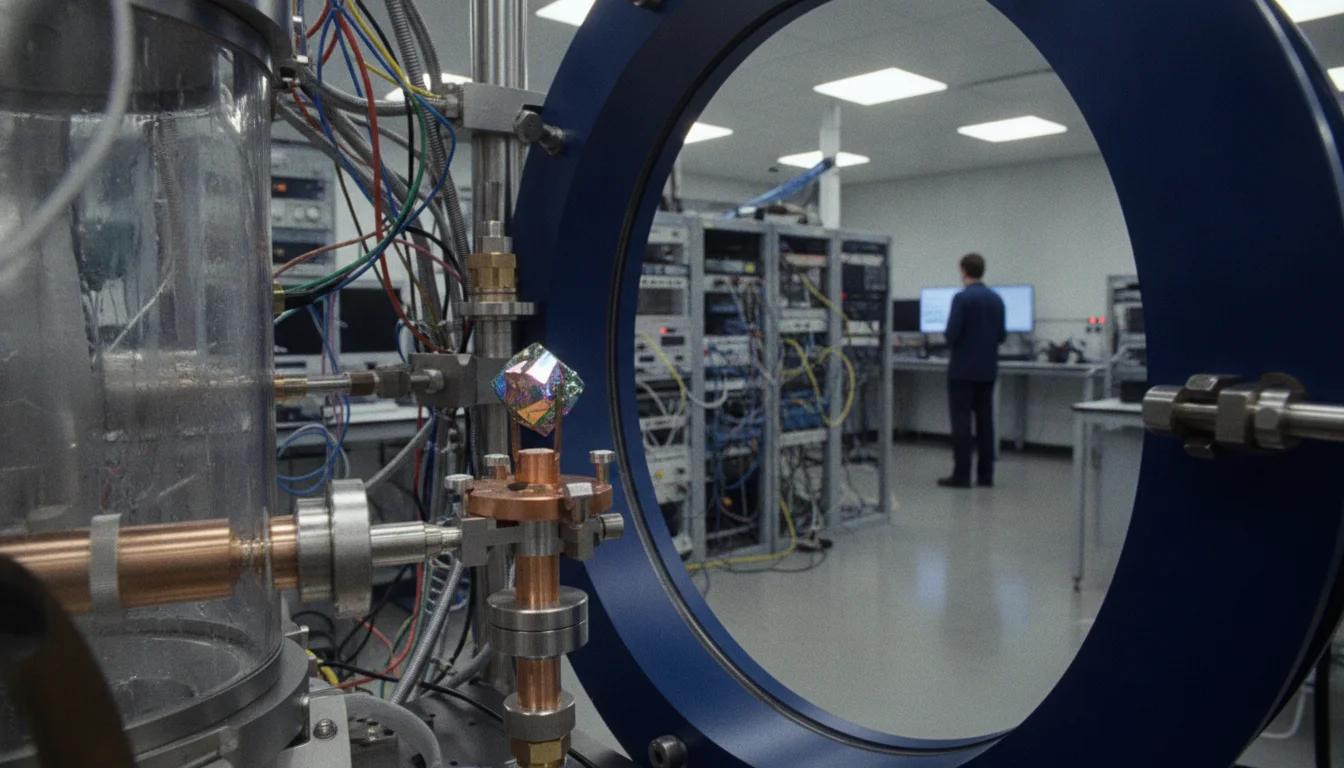
On August 26, 2026, Cambridge's Cavendish Laboratory publicly announced a breakthrough: researchers directly measured an unconventional magnetic state—altermagnetism—deep inside chromium antimonide (CrSb) and mapped its 3D order parameter in bulk CrSb. This milestone was reported in a Cambridge news release and subsequently published in Nature, marking what many in the field are calling a foundational step for the science of altermagnetism and its potential spintronic applications. The news placed CrSb at the center of a fast-evolving dialogue about how new magnetic orders can coexist with robust, room-temperature operability in simple, scalable materials. The same day, Cambridge researchers underscored that their measurements leveraged extraordinary magnetic fields to resolve a magnetism pattern that until now had been inferred primarily from surface-sensitive techniques. This dual reporting—Cambridge’s release and the Nature paper—provides a rare, well-documented look at how a bulk property previously suspected in CrSb is being observed with three-dimensional precision. For readers and practitioners following the Cambridge magnetism story, the convergence of a high-field bulk measurement and a rigorous 3D map represents a turning point in both theory and potential device integration. (phy.cam.ac.uk)
A striking aspect of the Cambridge account is the explicit description of the experimental approach. Researchers used a superconducting and resistive magnet setup capable of delivering very large magnetic fields to probe electrons deep inside CrSb, far beyond what surface-sensitive probes can reveal. Mengmeng Long, a joint-lead author in the Quantum Matter group, described the process: by tracking how electrons move deep inside CrSb under strong external fields, the team found spin-up and spin-down electrons with identical momentum occupying distinct energy levels. This energy splitting is the telltale signature of altermagnetism in CrSb and maps to a unique bulk order parameter pattern that mirrors the symmetry of CrSb’s crystal lattice. The Cambridge release emphasizes that the team was able to reconstruct the magnetic behavior throughout three-dimensional space, resulting in a pattern described as a six-petalled flower—the same geometry associated with a g-orbital in a hydrogen atom. The article underscores that this is not a surface illusion but a bulk property, a distinction that matters for both fundamental understanding and the potential to leverage CrSb in real devices. This bulk confirmation, in turn, supports years of theoretical predictions about CrSb’s altermagnetic character and strengthens the empirical footing for altermagnetism as a legitimate, technologically relevant magnetic state. (phy.cam.ac.uk)
The Nature paper referenced by Cambridge cements the moment with a formal, peer-reviewed statement. The article, titled 3D bulk-resolved g-wave altermagnetic order parameter in CrSb, reports the high-resolution three-dimensional mapping of the altermagnetic order parameter in CrSb and presents data that align with the predicted g-wave symmetry in a metallic altermagnet. Nature’s version of the work situates CrSb among a small but growing class of materials in which spin-splitting and magnetic order are decoupled in momentum space, a feature that could enable energy-efficient spintronic devices without requiring a net magnetization. The publication date for the online version is August 26, 2026, which matches the Cambridge release and helps timestamp the event for readers and researchers tracking the evolution of altermagnetism in CrSb. The paper’s authors argue that magnetic quantum oscillation measurements offer a bulk-sensitive way to map the order parameter in CrSb with 3D resolution, a methodological advance that could be applied to other altermagnetic candidates in the future. For researchers and industry watchers, the Nature paper provides a durable, citable foundation for CrSb’s altermagnetic behavior and sets the stage for subsequent experiments and potential device concepts. (doi.org)
The event is also documented in Cambridge’s own data and repositories, which provide access to the underlying measurements and data products that support the claim of bulk altermagnetism in CrSb. A Cambridge data repository entry dedicated to the Nature paper’s supporting data describes a comprehensive set of measurements performed in a 41.5 Tesla resistive magnet, using cryogenic conditions to keep CrSb in a regime where quantum oscillation effects reveal the bulk order parameter with high fidelity. This detail—the use of a 41.5 T magnet—emerges as a crucial technical datum illustrating why the Cambridge team could resolve a bulk altermagnetic signal in CrSb rather than a surface-confined signature. The repository notes include explicit parameters about temperature, magnetic field orientation, and the mapping geometry that underpin the reported 3D g-wave altermagnetic order parameter. While the primary narrative is the discovery, the repository provides essential transparency for researchers seeking to reproduce or extend the work. (repository.cam.ac.uk)
Why this matters goes beyond a single material or a single paper. CrSb has long been a focal material in the altermagnetism discourse because of its simple chemical composition, crystal symmetry, and high ordering temperatures, which together position it as a promising platform for practical spintronic concepts. Altermagnetism—the state in which a material exhibits momentum-dependent spin splitting without a net magnetic moment—offers a tantalizing blend of ferromagnetic-like spin polarization and antiferromagnetic-like compensation. If such a state can be controlled and exploited in devices, it could lead to memory elements and logic components that combine low energy consumption with fast switching, reduced crosstalk, and robustness to external magnetic perturbations. Cambridge’s 2026 CrSb findings build on earlier theoretical and experimental developments that suggested CrSb could host altermagnetic order, including prior demonstrations of how crystal symmetry can influence the emergence and manipulation of altermagnetic order in CrSb films. The combination of a bulk, three-dimensional confirmation and a direct, high-field mapping of the order parameter strengthens the case that CrSb is not only a laboratory curiosity but also a credible material for exploring altermagnetic physics in devices. This synthesis—experimental bulk confirmation paired with a symmetry-guided understanding—appears in several related lines of inquiry, including prior Nature work on crystal-symmetry manipulation of altermagnetic states in CrSb and subsequent studies of altermagnetic band structure in CrSb thin films. (nature.com)
A closer look at the broader context helps frame the significance of the CrSb Cambridge development. The field of altermagnetism has grown rapidly since the first theoretical proposals and experimental hints that certain antiferromagnets could host spin-split bands even without macroscopic magnetization. In CrSb, the hexagonal NiAs-type structure is central to the predicted g-wave altermagnetic order, and the observed bulk signal provides a clean benchmark for comparing bulk materials with corresponding thin films and heterostructures. The 2024–2025 Nature work on manipulating altermagnetic order in CrSb via crystal symmetry laid an important groundwork by showing that order can be tuned through symmetry considerations, while the 2026 Nature paper and Cambridge release take the essential next step: establishing that the same altermagnetic signature can be observed not just at the surface or in a specialized sample, but throughout the bulk of CrSb. In parallel, independent groups have reported complementary findings on ultrathin CrSb films, and some studies have begun to map the spin splitting across three-dimensional momentum space, reinforcing the idea that CrSb is a robust platform for exploring the interplay between crystal symmetry, spin physics, and transport phenomena in altermagnetic systems. The convergence of these results signals a maturing field with clearer pathways toward practical applications and a more precise vocabulary for describing altermagnetic phenomena across materials, thickness regimes, and device geometries. (nature.com)
Section 1: What Happened
The Announcement
Cambridge’s August 26, 2026 release
The central event is straightforward in its outward appearance: on August 26, 2026, a Cambridge team announced that altermagnetism—a form of magnetism that blends elements of ferromagnetism and antiferromagnetism—exists in CrSb not just at the surface but throughout its bulk. The release describes direct measurements of spin-splitting deep inside CrSb under extreme magnetic fields, culminating in a full three-dimensional map of the altermagnetic order parameter. The message is both empirical and carefully framed: this is a bulk confirmation of altermagnetism in CrSb, a result that addresses long-standing questions about whether altermagnetic behavior in CrSb is merely surface-related or intrinsic to the material. The Cambridge piece stresses the novelty of observing a bulk altermagnetic order parameter with three-dimensional resolution, a capability that had not been demonstrated in a real, three-dimensional crystal before. The team emphasizes the significance for spintronics, given CrSb’s combination of room-temperature ordering and abundant, inexpensive constituent elements. The release—anchored to the August date and to the broader scientific momentum around altermagnetism—reads as a careful, data-driven update on a rapidly evolving field. (phy.cam.ac.uk)
The Nature paper and the bulk map
The Nature article—3D bulk-resolved g-wave altermagnetic order parameter in CrSb—appears as the formal, peer-reviewed counterpart to Cambridge’s press briefing. It documents a robust, three-dimensional mapping of the order parameter in a bulk CrSb crystal, confirming the g-wave symmetry and the presence of spin-split electronic states in the absence of net magnetization. The paper places CrSb among the most compelling altermagnetic systems studied to date, and it anchors the Cambridge measurements in a wider global research effort to understand how symmetry and exchange interactions can give rise to a spin-polarized Fermi surface in a compensated magnet. The joint signaling from Cambridge and Nature creates a cohesive narrative for readers and researchers who want to trace the lineage from theoretical predictions to bulk confirmation and then to potential device concepts. (doi.org)
The technical backbone
A core element of the announcement is the demonstration that a 41.5 tesla field is necessary to probe CrSb’s bulk magnetism in a meaningful way. The Cambridge data repository corroborates the experimental conditions, noting that the 41.5 T field was crucial for attaining the deep, bulk-sensitive measurements that reveal the 3D g-wave altermagnetic order parameter. This detail matters for researchers who want to compare CrSb’s behavior with other altermagnetic candidates or to design experiments aimed at manipulating the order parameter via external fields, strain, or interface engineering. The high-field, low-temperature approach is not trivial; it represents a deliberate choice to push beyond the limitations of surface-sensitive techniques and to test the material under conditions where bulk electronic structure dominates the observable magnetic signatures. (repository.cam.ac.uk)
Section 2: Why It Matters
Impact on Spintronics
A new magnetic paradigm with practical potential
Altermagnetism holds the promise of spin polarization without the baggage of a net magnetic moment, which could translate into memory and logic devices that combine stability with low energy consumption and high switching speeds. CrSb’s simple composition, high ordering temperature, and compatibility with existing semiconductor-like processing steps position it as a practical testbed for translating altermagnetic concepts into device prototypes. The Cambridge release foregrounds this potential by arguing that altermagnetic materials could enable faster, smaller, and more energy-efficient electronic devices. The bulk demonstration in CrSb strengthens the argument that these magnetic states can be robustly harnessed in devices, not just observed as curiosities in carefully prepared thin films or surface regions. This shift from surface phenomena to bulk confirmation matters for device designers who must assess materials under realistic operating conditions, including applied fields and temperatures encountered in memory arrays and spin-based logic circuits. (phy.cam.ac.uk)
A comparison with conventional magnetic orders
To anchor readers who are navigating the altermagnetism literature, it helps to contrast CrSb’s altermagnetic behavior with classic ferromagnetism and conventional antiferromagnetism:
- Ferromagnetism: Spin alignment yields a net magnetic moment; devices can exploit straightforward magnetization switching but suffer from stray fields and cross-talk.
- Conventional Antiferromagnetism: Neighboring spins cancel out, reducing stray fields and enabling faster dynamics and higher-frequency operation, but with often subtle, challenging-to-measure signals.
- Altermagnetism (as observed in CrSb): Spin polarization in momentum space occurs without a net magnetization, enabling momentum-space spintronic effects that could combine the advantages of ferromagnets and antiferromagnets. The bulk CrSb measurements show that this order can be mapped in all three spatial dimensions, which supports the case that the phenomenon can be engineered in devices with predictable behavior across thicknesses and orientations. Cambridge’s and Nature’s reporting together provide a concrete, data-driven narrative that helps industry analysts compare CrSb with other altermagnetic systems and consider its suitability for proposed device concepts. (doi.org)
Industry and Academic Impact
What researchers and institutions are saying
A hallmark of this week’s coverage is how the Cambridge release frames the discovery as part of a broader shift in magnetic materials research. The combination of a bulk measurement with a full 3D map provides a template for how altermagnetic order can be studied across materials and geometries, potentially accelerating the pipeline from fundamental physics to applied devices. Cambridge’s own framing emphasizes the importance of bulk observation, clarifying that the measured altermagnetic order is intrinsic to CrSb rather than a surface artifact. The peer-reviewed Nature paper complements this, offering a rigorous, citable record that other groups can reference as they design experiments, attempt to replicate the results, and explore integration strategies for spintronic architectures that leverage altermagnetic spin splitting. (phy.cam.ac.uk)
How this updates the field’s knowledge base
Academic discourse around altermagnetism has progressed rapidly over the last few years, moving from theoretical proposals to multiple experimental validations in various materials. CrSb has repeatedly appeared as a leading candidate because of its crystal symmetry and robust electronic structure. The Cambridge update, supported by Nature’s formal publication, adds a critical data point: CrSb’s altermagnetic order persists in the bulk and can be resolved in three dimensions, which has implications for interpreting transport measurements and for designing interfaces with other materials in heterostructures. The cross-pollination of results from ultra-high-field techniques, ARPES-like bulk mapping, and magnetotransport studies across several groups is beginning to yield a more precise map of which CrSb-like materials can host robust altermagnetic order at or near room temperature and under practical field conditions. (phy.cam.ac.uk)
Public and Policy Context
Implications for funding, standards, and collaboration
As the field of altermagnetism matures, the Cambridge CrSb results are likely to influence funding agendas and collaborative initiatives across physics, materials science, and engineering. Data-driven validation—such as 3D mapping of order parameters and bulk confirmation—addresses a common concern among funding agencies: whether new magnetic states can withstand realistic device operating regimes and can be studied with scalable, replicable methods. The CrSb work, anchored by Cambridge and Nature, offers a robust reference point for evaluating proposals that aim to translate altermagnetic phenomena into hardware. In addition, as device concepts using altermagnetic materials move closer to demonstration at the chip level, researchers and industry partners may seek to standardize measurement approaches to ensure comparability across labs and institutions. The Cambridge release and its Nature companion provide benchmark methods and datasets that can inform such standards-building efforts. (phy.cam.ac.uk)
Section 3: What’s Next
Timeline and Next Steps
Immediate research directions
With bulk altermagnetism now established in CrSb, researchers are likely to pursue several parallel tracks:
- Replication and extension: Independent labs will attempt to reproduce the bulk CrSb altermagnetism mapping, test CrSb crystals from different growth methods, and examine how defects, strain, and sample geometry influence the observed g-wave order parameter.
- Thickness dependence: Following the two-dimensional limit studies that show changes in altermagnetic behavior with reduced thickness, researchers may explore whether CrSb maintains bulk-like altermagnetic order as thickness decreases to tens of nanometers or even single-digit nanometers. Early ultrathin CrSb studies in related work suggest thickness can tune or even suppress the altermagnetic state, so carefully designed experiments are expected to test the boundaries of CrSb’s altermagnetism across thickness regimes. (sciencedirect.com)
- Device-oriented explorations: Proposals to couple CrSb with proximitized or topological materials, or to create CrSb-based heterostructures, are likely to emerge more prominently as a result of the bulk confirmation. The field will watch for reproducible demonstrations of spin-polarized transport linked to bulk altermagnetic order and seek robust, reproducible switching mechanisms that can be integrated into memory or logic devices. (doi.org)
Longer-term milestones
- Scaling to device platforms: If CrSb-based platforms show consistent, scalable behavior, researchers will pursue integration strategies that align with semiconductor process flows, assess reliability under device-level cycling, and quantify energy-per-bit improvements from altermagnetic spin polarization.
- Cross-material comparisons: The CrSb findings will catalyze comparative studies across CrSb-like compounds and other hexagonal NiAs-type materials, helping the community delineate which crystal symmetries and electronic structures yield the most robust, tunable altermagnetic signals.
- Theoretical refinement: The experimental bulk confirmation will feed back into theory, refining models of how g-wave altermagnetic order arises from sublattice symmetry and how external fields, strain, or interfaces modify the energy landscape that stabilizes the order parameter.
What to watch for in the near term includes follow-up papers in Nature and related journals that extend 3D mapping to different CrSb morphologies or related materials, and independent replication studies detailing the sensitivity of the bulk altermagnetic signal to experimental parameters such as temperature and field orientation. The combination of a robust bulk signal and detailed real-space (or k-space) mapping will be a touchstone for subsequent research efforts and for journals that aim to publish comparable results from other laboratories. (doi.org)
Next Experiments and Collaboration Opportunities
Potential collaboration paths
Cambridge’s CrSb breakthrough invites collaboration across laboratories that specialize in high-field measurements, ARPES, and transport experiments. The field can benefit from multi-institution consortia that share sample preparation facilities, cryogenic equipment, and high-field magnet capabilities. Shared data repositories, like the Cambridge data set for CrSb, will be vital in enabling cross-validation of results and in accelerating the pace at which independent teams can build upon the initial findings. The 41.5 T magnet, while extraordinary, is not a standard tool in all labs; collaborations that combine narrow-field and ultra-high-field capabilities could help generalize the CrSb altermagnetism story beyond a single facility. (repository.cam.ac.uk)
What readers and investors should look for
Industry readers should monitor how the CrSb altermagnetism findings translate into measurable device improvements: lower energy consumption for switching, reduced cross-talk in densely packed memory arrays, and the possibility of high-frequency operation enabled by spin-polarized transport in a bulk altermagnetic state. While these outcomes remain aspirational at this stage, the Cambridge-Nature sequence provides a credible blueprint for how to move from fundamental discovery to device-relevant performance metrics. Analysts should also track any standardization efforts around measurement and reporting of altermagnetic signals, especially as multiple materials enter the field and as the community seeks comparable benchmarks. (phy.cam.ac.uk)
Closing
The August 26, 2026 events mark a watershed moment for CrSb and the broader discourse on altermagnetism. Cambridge’s direct bulk observation, combined with the Nature paper’s detailed mapping, offers the field a rare combination of empirical clarity and theoretical grounding. The implications for spintronics and magnetic memory are still being explored, but the path forward is now much clearer: altermagnetism in CrSb is not a surface illusion but a bulk reality with a well-defined order parameter that can be probed in three dimensions and under extreme magnetic fields. As researchers across the world begin to replicate, refine, and extend these findings, Cambridge’s CrSb milestone will likely become a reference point in discussions about how symmetry, electronic structure, and magnetism intersect to create the next generation of magnetic materials. The collaboration between experimental prowess and rigorous peer review demonstrated here offers a model for how data-driven science can move quickly from hypothesis to validated knowledge, and how such knowledge can, in time, filter into practical technologies that reshape the device landscape. For readers and practitioners watching CrSb magnetism Cambridge developments, the coming months will be a period to watch closely as more labs publish corroborating results and as device-oriented studies begin to test the real-world potential of altermagnetic CrSb. (phy.cam.ac.uk)
References and primary sources
- Cambridge Cavendish Laboratory news release: Scientists confirm a new type of magnetism deep inside a material (August 26, 2026). This release provides the first bulk confirmation of altermagnetism in CrSb and foregrounds the 3D mapping of the order parameter. [Cambridge release] (phy.cam.ac.uk)
- Nature: 3D bulk-resolved g-wave altermagnetic order parameter in CrSb (online August 26, 2026). The peer-reviewed paper documents bulk CrSb altermagnetism with a 3D g-wave order parameter map. [Nature paper] (doi.org)