Cambridge Unveils Time-Crystal Metamaterial in Nature
Researchers at Cambridge demonstrate a time-crystal metamaterial that self-organizes movements into a synchronized oscillation, marking a significant…
 By Thomas Whitfield · 27 October 2026 · 11 min read
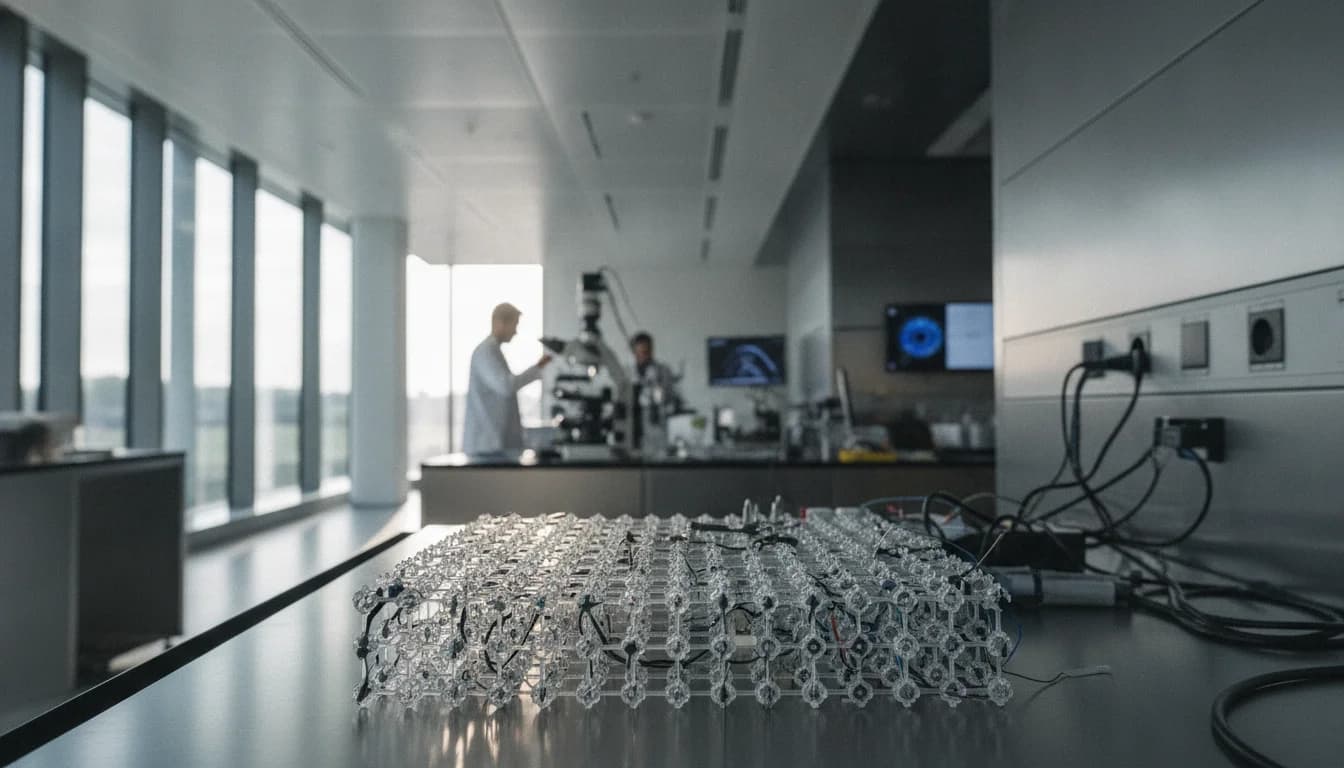
On October 14, 2026, Cambridge researchers announced a landmark demonstration of a time-crystal metamaterial in Nature, revealing a mechatronic structure that can organize its own movements into a single, global beat. The work, led by the Cavendish Laboratory at the University of Cambridge and conducted in collaboration with the Universities of Birmingham, Amsterdam, Lyon, Delft, and Leiden, marks a high-profile milestone for time-crystal research and for the broader field of metamaterials. This event, captured in a formal Nature publication and accompanied by multi-institution press coverage, places the Cambridge effort at the center of a shifting landscape in adaptive materials and robotics. For readers tracking technology and market trends, the Cambridge time-crystal metamaterial story offers a clear data point about how non-reciprocal interactions in engineered matter can yield new modes of coordinated motion, with potential implications for autonomous systems, soft robotics, and intelligent materials design. Cambridge Cavendish news release; University of Birmingham press release (phy.cam.ac.uk)
In a compact, data-rich release that accompanies the Nature paper, the Cambridge team details how a honeycomb of active units self-organizes when reciprocity is broken, producing a globally synchronized oscillation that behaves like a time crystal. The gearwork of sensors, actuators, and elastic elements—a true mechatronic metamaterial—demonstrates a vibrational order that emerges from local interactions rather than a central controller. This demonstration is not just a theoretical curiosity: it signals a concrete path toward reconfigurable, self-coordinating structures that could underpin future bio-inspired robots and adaptive devices. The significance is underscored by the joint authorship spanning Cambridge and its European collaborators, a hallmark of large-scale, cross-institution collaboration in cutting-edge materials physics. For a broader audience, this event foregrounds Cambridge’s leadership in experimental metamaterials and time-crystal physics, while also highlighting the growing ecosystem of European partnerships in this space. Cambridge statement; Birmingham press release (phy.cam.ac.uk)
One Liftable Fact According to the Nature paper published October 14, 2026, Cambridge-led researchers demonstrated a time-crystal metamaterial built from a 2D honeycomb of 37 active units that self-oscillated at about 30 Hz before evolving into a globally synchronized state. This central finding comes from the Nature publication detailing wave coarsening and the non-reciprocal interactions that drive the transition to time-crystalline order, and is corroborated by Cambridge’s own press materials describing the 37-unit honeycomb and the 30 Hz figure. The sentence below distills the core event for citation in subsequent coverage. (Source: Nature; Cambridge press materials) (nature.com)
What Happened Announcement details
- On October 14, 2026, a cross-institution team released a Nature paper describing a mechatronic metamaterial that behaves as a time crystal. The collaboration includes the Cavendish Laboratory at Cambridge, the University of Birmingham, and the Universities of Amsterdam, Lyon, Delft, and Leiden. The announcement situates time-crystalline behavior in a non-reciprocal, actively driven metamaterial, where local interactions among components give rise to global, temporally ordered motion. The formal publication and accompanying press materials mark a coordinated public unveiling of the concept in a peer-reviewed journal, signaling a milestone for both fundamental physics and practical metamaterial design. See the Cambridge press release for the Cambridge-led narrative and the Birmingham release for additional institutional context. (phy.cam.ac.uk)
- The Nature paper, “Wave coarsening drives time crystallization in mechatronic metamaterials,” presents experimental evidence of wave coarsening in 2D and 1D active elastic media and documents how patterns merge into a single, low-frequency, time-crystalline state. The paper lays out the experimental platform, the sequence of pattern formation, and the nonlinear dynamics that enable the global rhythm. While the full text is accessible through Nature’s site, Cambridge and Birmingham summaries emphasize the central mechanism: non-reciprocal coupling among mechanical elements drives spontaneous organization into a coherent time-ordered state. The publication date and DOI are cited in the Cambridge release and are reflected in the Nature article record. (nature.com)
Key facts and timeline
- The model material begins as a 2D honeycomb assembly of 37 active units. Under driving conditions that break reciprocity, individual elements begin self-oscillating at approximately 30 Hz, a near-term precursor to global order. Over time, longer-wavelength patterns emerge and dominate, culminating in a single, synchronized, time-crystal-like motion of the entire sheet. These experimental steps are described in the Cambridge account as well as the Birmingham press material, which quotes project participants and provides context for the pattern coarsening process. The 30 Hz figure is a concrete, cited data point that anchors the observed dynamical transition. (phy.cam.ac.uk)
- A second experimental pathway examined in the same project involves a ring structure containing 24 motorized units. In this setup, early high-frequency deformation patterns gradually coarsen into a slow collective cycle, illustrating the robustness of time-crystalline behavior across geometric configurations. This spatially distinct demonstration reinforces the claim that non-reciprocal interactions can yield stable, global temporal order in diverse active metamaterial architectures. The Birmingham report provides these details, underscoring the systematic exploration across multiple device topologies. (birmingham.ac.uk)
- The collaboration’s scope spans six institutions, including Cambridge, Birmingham, Amsterdam, Lyon, Delft, and Leiden. The joint effort, documented in both the Cambridge page and the Birmingham release, highlights the breadth of international academic participation that has become a hallmark of contemporary metamaterials research. While the exact configurations differ between the honeycomb and ring geometries, the shared mechanism—a non-reciprocal interaction network driving wave coarsening into a global time-crystal state—binds the project’s findings together. This cross-institutional dynamic is emphasized by the press materials as a key strength of the study. (phy.cam.ac.uk)
Why It Matters Scientific context and significance
- Time crystals have long been a theoretical and experimental interest in condensed matter and non-equilibrium physics. The Cambridge-led Nature paper translates this concept into a tangible metamaterial system, demonstrating that time-crystalline order can arise in macroscopic, engineered structures driven by internal activity rather than external periodic forcing alone. This result provides a bridge between the abstract notion of time crystals and practical, scalable devices that could be programmed to exhibit repeatable, robust temporal patterns. The Nature publication and accompanying Cambridge narrative frame the finding as a step forward for both fundamentals and applications in active matter and metamaterials. (nature.com)
- The mechanism at the heart of the demonstration—non-reciprocal coupling among neighboring elements—offers a novel design principle for future metamaterials. By enabling directional interactions where one element’s response to another is not mirrored back, designers gain a handle on collective dynamics that can be tuned to produce programmable time-dependent behavior. The Cambridge and Birmingham materials describe this non-reciprocal framework as essential to achieving the synchronized, time-crystal state, and the broader implications for how active systems can self-organize into functional, time-ordered configurations. This has potential ramifications for soft robotics, adaptive architecture, and other fields where coordinated motion without centralized control is valuable. (phy.cam.ac.uk)
- The collaboration’s geographic breadth—spanning Cambridge, Amsterdam, Birmingham, Lyon, Delft, and Leiden—also signals a broader scientific ecosystem forming around time-crystal metamaterials. The Nature article’s author list and the multiple university press releases underscore a growing, interconnected network of researchers and institutions pursuing parallel lines of inquiry, replication, and extension. The cross-border nature of the project aligns with broader trends in European research funding and collaboration aimed at accelerating breakthroughs in metamaterials and their real-world deployment. (nature.com)
Industry and market context
- While the current output is primarily a scientific milestone, observers in the technology and materials communities are watching for downstream implications in robotics, aerospace, and industrial automation. The time-crystal metamaterial concept suggests a pathway to self-organizing, adaptable structures that could reduce reliance on centralized control algorithms, potentially lowering system complexity in certain robotic platforms. These possibilities are discussed in industry-angled coverage and are consistent with the broader trends outlined in metamaterials research, where active, programmable components are increasingly integrated into functionally diverse devices. The Cambridge and Birmingham releases place this discovery within a continuum of work that seeks practical leverage from time-domain control in metamaterials. (phy.cam.ac.uk)
- Analysts and researchers are likely to monitor follow-on work that extends the observed phenomena to three dimensions, different material systems, and higher-frequency regimes. The Nature paper itself frames open questions about the transient physics of non-potential, actively driven systems, inviting further exploration of how wave coarsening scales with size, geometry, and material properties. In coverage and commentary from Cambridge and partner institutions, there is an emphasis on the potential for multi-pattern functionality and programmable morphologies as next steps. This suggests a pipeline from fundamental discovery to practical design guidelines and prototype devices. (nature.com)
What’s Next Timeline and next steps
- Immediate follow-ups are likely to focus on expanding the architectural repertoire of time-crystal metamaterials. The research teams have already demonstrated two distinct geometries—the 2D honeycomb and a 24-unit ring—showing that the phenomenon is not limited to a single form factor. Researchers will likely explore additional topologies, material modalities (e.g., alternative actuation schemes, sensor configurations), and boundary conditions to further map the parameter space in which time-crystalline order can be stabilized and controlled. The Cambridge and Birmingham sources indicate a broader program of exploration in active metamaterials, which typically includes scaling studies, stability analyses, and attempts to actively switch between multiple stable motion patterns. (phy.cam.ac.uk)
- In terms of dissemination and validation, the Nature publication marks a high-profile moment, but replication across laboratories remains a critical step for establishing robustness. The Nature record and the associated press coverage emphasize the importance of independent verification and subsequent experiments that test the generality of non-reciprocal coupling as a design principle. The broader research community, including teams at Amsterdam and Leiden, is expected to pursue follow-on papers and conference presentations to broaden the empirical base and to test the limits of time-crystal metamaterials across varying scales and conditions. (nature.com)
- Funding and institutional partnerships will likely intensify as the potential of time-crystal metamaterials becomes more visible. The cross-institution collaborations have already established a model for joint research programs that combine robotics, materials science, and physics. As the field evolves, new consortia and funding calls may emerge to support iterative development from laboratory demonstrations toward applied prototypes with real-world performance criteria. Observers should monitor university newsrooms and Nature communications for updates on additional partners and potential commercialization pathways. (phy.cam.ac.uk)
Substantive details for researchers and practitioners
- Experimental platform and data points. The honeycomb arrangement with 37 active units and the ring with 24 motorized units illustrate how the same fundamental mechanism—non-reciprocal interactions—manifests in different geometries. The initial self-oscillation around 30 Hz provides a baseline for the dynamic regime that leads to global order, followed by a transition to a slower, collective rhythm as the system coarsens. These figures—37 units, 24 units, and 30 Hz—anchor future work that seeks to quantify the relationship between unit count, geometry, and emergent time-crystal behavior. See the Cambridge description of the experimental setup and the Birmingham press notes for these numerical anchors. (phy.cam.ac.uk)
- Theoretical framing. The Nature paper situates time crystallization in the context of non-equilibrium physics and active solids, with a focus on how dissipation, driving, and non-potential interactions generate ordered temporal patterns. This theoretical angle will guide subsequent modeling efforts, experimental design, and potential cross-pollination with related topics such as topological edge modes and nonlinear wave phenomena. The Cambridge summary highlights these theoretical touchpoints and points readers to the broader corpus of active matter research that informs the study. (nature.com)
- Community reaction and scholarly uptake. Since the publication date, the Nature article has begun to attract attention from physics and engineering outlets that track time-crystal research and metamaterial innovation. The coverage notes the significance of achieving a tangible, macroscopic time-crystal state in a programmable mechanical system, a step beyond purely quantum platforms that were historically associated with the concept. Coverage notes and related commentary from Cambridge and partner institutions place the work in the global line of inquiry into programmable, adaptive matter. Readers can consult the Nature page and the Cambridge press summary for primary sources and official context. (nature.com)
A Closer Look at the Collaboration
- The cross-institution collaboration represents a model for complex, multi-site experiments in metamaterials. The Cambridge page emphasizes the role of the Cavendish Laboratory and the involvement of the Birmingham, Amsterdam, Lyon, Delft, and Leiden groups, illustrating how a distributed team contributed to both the experimental platform and the theoretical framing. The Birmingham press release confirms the involvement of multiple universities and underscores the collaborative nature of the effort, including the sharing of experimental apparatus and data. This joint approach is typical of high-impact metamaterials research, which often requires a combination of fabrication facilities, advanced actuation systems, and sophisticated measurement capabilities that are distributed across institutions. (phy.cam.ac.uk)
- The dissemination strategy for this milestone includes a Nature article, university press releases, and cross-institution communications. The three-pronged approach ensures that researchers, practitioners, and policymakers can access the core technical results from a primary journal and then explore institutional interpretations and implications through university channels. Readers seeking original documentation can turn to the Nature article (Wave coarsening drives time crystallization in mechatronic metamaterials) and to the Cambridge and Birmingham press releases for accessible summaries and direct quotes from project participants. (nature.com)
Closing
The Cambridge time-crystal metamaterial achievement represents a milestone that sits at the intersection of fundamental physics, advanced materials, and future-enabled robotics. The October 14, 2026 Nature publication, supported by Cambridge and Birmingham press materials, confirms that a non-reciprocal, actively driven metamaterial can spontaneously organize into globally synchronized temporal order, a phenomenon with potential implications for how we think about programmable matter and autonomous systems. While the immediate takeaway is a scientific proof of concept, the broader context suggests a growing research ecosystem exploring scalable, time-directed metamaterials that could influence design paradigms across engineering disciplines. Readers and practitioners should watch for follow-up studies, additional topology explorations, and potential early-stage demonstrations that translate time-crystal concepts into practical devices. For ongoing updates, follow Cambridge’s research news and Nature communications in this rapidly evolving field. (phy.cam.ac.uk)
For readers seeking primary sources and original data:
- Cambridge Cavendish Laboratory news release: Vibrating material organises itself into a single beat (October 14, 2026) — describes the experimental setup, non-reciprocal coupling, and the global time-crystal state. Link: Cambridge page. (phy.cam.ac.uk)
- University of Birmingham press release: Chaos to coordination: vibrating material organises itself into a single rhythm (October 14, 2026) — details the 2D honeycomb and 24-unit ring experiments and the nature publication. Link: Birmingham page. (birmingham.ac.uk)
- Nature: Wave coarsening drives time crystallization in mechatronic metamaterials (October 14, 2026) — the formal, archival primary source for the scientific result. Link: Nature article. (nature.com)