UK physics funding cuts 2026: Risks and responses

The year 2026 marks a pivotal moment for UK physics. UK physics funding cuts 2026 are not merely micro-adjustments in grant lines; they pose a potential reorientation of how the country produces knowledge, trains scientists, and participates in international research infrastructure. The immediate headlines are stark: UKRI has canceled funding for several high-profile physics infrastructure projects, including components tied to CERN’s LHCb upgrade and an Electron-Ion Collider project in the United States, as well as national facilities here at home. These decisions are not isolated budget trivia; they reverberate through university physics departments, early-career researchers, and the UK’s standing in global science collaborations. (iop.org)
Yet the deeper drumbeat behind UK physics funding cuts 2026 is more complex. While policymakers emphasize “doing fewer things better” and redirecting scarce resources toward AI, life sciences, and targeted mission outcomes, the data tell a more nuanced story. The Institute of Physics warned in 2025 of a “perfect storm” in university physics funding, predicting that more than one-quarter of UK physics departments could face closure within two years, with widespread job losses and program cuts. That projection underscores a trend where the financial pressures on physics are both acute and cascading across education, industry, and national security priorities. The current trajectory, if unaddressed, could slow the pipeline of talent and disrupt long-running collaborations that underpin the UK’s technological leadership. (iop.org)
This piece argues that the UK should not treat research funding cuts as a purely financial adjustment; it must be understood as a policy choice with strategic consequences. The thesis is clear: UK physics funding cuts 2026 threaten both the health of UK science ecosystems and the country’s capacity to sustain international collaborations that underpin high-technology industries and national security. Yet there is a path to a more resilient model—one that preserves core physics capabilities while still prioritizing strategic investments. The argument unfolds in three parts: first, the current state and its drivers; second, why the dominant narrative misses a broader set of costs and opportunities; and third, what this means for policy, universities, and industry.
The Current State
Funding landscape in 2026 The most consequential signal from early 2026 is that UK funding for major international physics infrastructure has been cut. UKRI confirmed the cancellation of UK funding for four significant projects, including the LHCb upgrade at CERN, a United States–based Electron-Ion Collider, and two national facilities within the UK project portfolio. The moves are framed by UKRI leadership as strategic reductions intended to reallocate resources to priorities with greater domestic relevance or shorter-term impact, but the physics community has framed them as a material withdrawal from globally competitive, long-horizon programs. The Institute of Physics summarized the situation and highlighted the broader context: a government and funder environment pressing for efficiency and prioritization, even when that means stepping back from large-scale, globally integrated facilities. (iop.org)
This bleeding effect is occurring alongside broader budgetary pressures within STFC and UKRI, which have themselves faced scrutiny about how to balance ongoing facility costs, subscriptions to international collaborations, and the costs of electricity and operations at national facilities. The Financial Times and other outlets have reported that the overall package of cuts is part of a broader attempt to squeeze a difficult budget into a sustainable portfolio of projects. Critics argue that the cuts risk undermining the UK’s ability to deliver on both fundamental discoveries and the downstream technologies that rely on such discoveries. Supporters of the approach contend that limited funds demand tough choices and that focusing on high-potential, near-term impact areas can yield better national returns. (ft.com)
Prevailing assumptions about science funding A common assumption in public debates is that science funding remains broadly protected or that cuts are occasional, isolated adjustments rather than systemic redesigns. In reality, the data suggest a more testing environment for physics in particular. The UK government has signaled a preference for allocating resources toward AI, life sciences, and other rapidly advancing sectors, and the narrative of “do fewer things better” has gained traction among funders and policymakers. While that framing aims to improve efficiency, it also raises questions about whether crucial foundational programs in physics—many of which feed future technologies—will be preserved at a scale that sustains UK leadership. The Financial Times has reported on the reallocation trend and the persistence of debates over what counts as “better” research investments, a debate that intersects with the physics community’s concerns about long-run competitiveness. (ft.com)
Data points and implications for departments Beyond the headlines, the physics workforce and university departments are feeling the climate more acutely. The Institute of Physics’ 2025 assessment, Physics Matters: Funding the Foundations of Growth, documented a range of pressures—grant volatility, inflation, visa policy shifts, and electricity costs—that create a “perfect storm” for UK physics departments. The report’s headline finding—that roughly a quarter of departments could face closure in a short time frame—paints a stark portrait of risk for capacity, access, and talent mobility within the sector. If these trends persist, the UK could see a widening gap between capacity to deliver world-class research and the needs of industry, defense, and technology ecosystems that rely on physics expertise. (iop.org)
The current state also interacts with international collaborations that have long defined UK physics strengths. The LHC program at CERN has been a prime example of successful global science diplomacy and shared infrastructure. The cancellation of UK funding for the LHCb upgrade sends a signal about the country’s prioritization levers and risk tolerance for multi-party projects; the broader implication is a potential retreat from a leadership role in some of the largest, most demanding physics experiments of the last two decades. The Institute of Physics’ briefing on the canceled projects underscores the importance of careful policy design to avoid undermining international partnerships that have yielded scientific and economic dividends for the UK. (iop.org)
Prevailing assumptions vs. the data, and the broader context While many observers emphasize that the science budget remains large in absolute terms, the relative compression of funding for physics within that envelope matters. The debate increasingly centers on whether the allocations reflect a coherent, long-term strategic plan for the UK’s scientific and technological future or a series of ad hoc reallocations in response to immediate cost pressures. Some coverage notes that UKRI’s reallocation, framed as “doing fewer things better,” has sparked concern about gaps in curiosity-driven research and in early-career development pipelines. Policymakers note that the nation remains committed to science, including substantial investments in AI and other high-priority areas, but the question remains: will the cuts to physics undermine those broader ambitions over the next decade? The reporting from The Guardian and other outlets highlights the tension between headline funding levels and the strategic value of physics as a foundation for future capabilities. (theguardian.com)
Why I Disagree
Re-prioritization must not become de-prioritization of fundamentals The core of UK physics funding cuts 2026 debate should pivot from short-term budget numbers to a broader assessment of what constitutes national capability in science and technology. Redirecting funds toward AI, quantum-enabled life sciences, or other high-profile priorities can, if designed with care, accelerate growth in adjacent sectors. But there is a risk that insofar as physics underpins many of these advanced technologies—quantum, detectors, materials science—a sustained, robust foundation for curiosity-driven inquiry and for infrastructure that underpins long-tail discoveries is essential. The argument for refocusing funds must be balanced with recognition that foundational physics is often the seedbed for later, disruptive applications. When departments foresee closures or program cuts, the pipeline for future talent—students, postdocs, early-career researchers—can be damaged, potentially reducing the long-run innovation capacity of the country. The IOP’s 2025 report and subsequent coverage highlight exactly this tension between near-term savings and long-term capability. (iop.org)
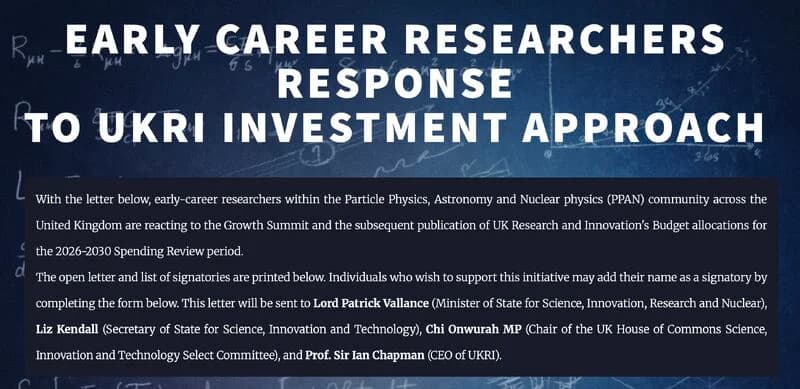
The risk to early-career researchers and talent pipelines One of the most consequential costs of UK physics funding cuts 2026 is to early-career researchers. The UK’s competitiveness in attracting and retaining young physicists depends on a stable, predictable funding environment, a steady stream of postgraduate and postdoctoral opportunities, and visible career trajectories within academia and industry. When funding cycles become uncertain and when departments face potential closures, researchers—particularly those just starting their careers—will seek opportunities elsewhere or delay critical research programs. The Guardian’s reporting on potential “loss of a generation” of UK scientists emphasizes this dynamic and cautions that early-career researchers may pursue opportunities in more financially stable environments abroad or in industry, thereby eroding the UK’s long-term human-capital base. (theguardian.com)
International collaborations and the long-term cost of retrenchment UK physics has benefited tremendously from international collaborations, including CERN projects and partnerships with U.S. national laboratories on nuclear and particle physics initiatives. Cancelling or delaying funding for shared facilities can disrupt these collaborations and reduce the UK’s influence on the direction of big-science programs. The Financial Times report on cutting more than £250m in planned physics infrastructure funding notes that such moves come alongside ongoing commitments to international partnerships, raising questions about the sustainability of a leadership role in global physics. In a landscape where big facilities require multi-year investments and shared risk, reductions in UK funding can produce a chilling effect—reducing the UK’s bargaining power as a collaborator and potentially increasing the cost to partner nations of sustaining joint projects. This dynamic matters not just for physics; it touches on the UK’s broader strategy for research-driven economic and security outcomes. (ft.com)
A counterargument worth engaging Proponents of tighter budget discipline argue that physics cannot be shielded from hard choices and that “fewer but better” projects can lead to stronger, more impactful outcomes. They point to successful reallocations in other sectors and to the need to align science with national priorities that deliver tangible benefits in terms of jobs, industry growth, and societal outcomes. The defense of this position is not to deny risk or the possibility of missteps but to argue for a framework that preserves core capabilities while still enabling breakthrough work. The challenge lies in translating that framework into funding mechanisms that provide stability, transparent criteria, and accountability while avoiding the worst consequences of abrupt cuts to departments that are already stretched. The coverage from FT and Guardian demonstrates that the political and funding logic is contested, and a productive path forward requires a credible plan that aligns short-term savings with long-term strategic outcomes. (ft.com)
What This Means
Implications for universities, industry, and national capabilities The immediate implication for universities is operational: fewer funded projects can mean fewer research positions, delayed equipment upgrades, and potential program terminations. The UK’s physics departments are not isolated from labor markets in industry or defense; they supply the technical workforce that underpins sensing, imaging, materials, and computational capabilities adopted across multiple sectors. When departments face closure or scaled-back programs, the regional and national innovation ecosystems lose critical nodes of expertise, collaboration networks, and training pipelines. The IOP’s warnings about job losses and degree-program reductions translate into a broader risk for the UK’s future industrial base and its ability to translate fundamental discoveries into products, processes, and services. The long-run consequence could be weaker retention of top talent and a slower rate of domestic technological advancement. (iop.org)
Implications for policy, funding models, and governance The current moment calls for a deliberate rethinking of how the UK funds physics, balancing immediate systemic pressures with the need to sustain foundational capabilities. If the goal is to maintain a world-class physics ecosystem that can feed into CERN collaborations, national facilities, and high-tech industries, then policy design should emphasize:
- Stability in core funding lines for physics departments and research groups, combined with predictable multi-year horizons so teams can plan capital investments and staffing.
- A tiered funding approach that preserves curiosity-driven research alongside mission-oriented programs, with clear criteria and independent reviews to minimize politicization of allocations.
- Robust support for postdoctoral and early-career researchers, including bridge funding during cycles of budget reallocation, to prevent talent attrition.
- Structured engagement with international partners to diversify funding across projects and regions, reducing over-reliance on any single country or mechanism. These ideas align with the observed emphasis on efficiency and strategic focus while acknowledging the essential role of physics in long-term growth, security, and competitiveness. The debate about how to implement such a model is ongoing, as reflected in contemporary reporting on UKRI’s funding choices and the physics community’s responses. (iop.org)
How readers and policymakers can approach a constructive path forward A constructive path forward requires both humility and clarity: humility to acknowledge genuine budget pressures, and clarity about the strategic non-negotiables for UK science. Practically, this means:
- Publishing a transparent, publicly accessible framework that explains how core physics programs contribute to national priorities and how funding decisions are made.
- Creating protected cores for essential physics departments, with formal channels for contingency funds to protect early-career researchers and critical equipment, even in lean years.
- Establishing channels for industry and academia to co-create high-impact, near-term applications that leverage physics expertise without compromising long-term fundamental research.
- Sustained investment in international collaborations that maximize UK influence and mitigate the risk of unilateral retrenchment, ensuring that Britain remains a reliable partner in major science infrastructure. These steps are not a guarantee against negative outcomes, but they offer a framework to reconcile budget realities with the imperative to maintain world-class physics capabilities. The broader discussion around the economics and governance of science funding supports the view that well-designed, data-informed policies can sustain both groundbreaking discovery and practical, near-term economic returns. (theguardian.com)
Closing
The objective of UK physics funding cuts 2026 should not be to hollow out a national science program in the name of efficiency. Instead, the goal must be to preserve a robust, flexible foundation for physics that can adapt to changing priorities while staying committed to long-run strategic advantages—talent development, international leadership, and the ability to translate fundamental discoveries into technologies that power growth. The data—and the voices of researchers working at the coalface—make a compelling case for policy recalibration rather than wholesale retraction. If the UK can design a funding architecture that protects core physics while enabling targeted, outcome-driven investments, the country can still harness physics as a platform for future prosperity. The stakes are high, but the opportunity for a more resilient, innovative research system remains within reach.
Ultimately, the question for Cambridge Review and its readers is not whether to reduce spending on physics, but how to reduce it in ways that preserve the UK’s capacity to generate knowledge, train the next generation of scientists, and sustain international partnerships that yield both scientific and economic dividends. The moment demands a careful balance between prudent budgeting and ambitious, long-horizon science—an approach that will determine the UK’s standing in global physics for years to come. (iop.org)